


Unofficial guide. Not the National Monuments Service, the OPW, Fáilte Ireland or the landowner. Disclaimer
At a glance
- TypeReligious house - Augustinian canons
- Date or period mentioned7th-century
- Condition (as surveyed)Ruined
What to look for
- Cloister
- Graveyard
Picked out from the Archaeological Survey description below.
Can you visit?
- No source says it is open to the public.Most monuments in Ireland stand on private farmland.
- Ask the landowner before crossing fields, close gates, leave the stones as you find them.Visiting responsibly
History and description
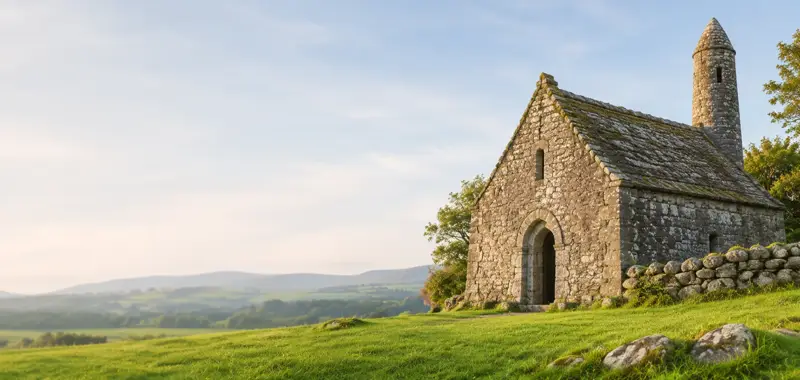
On a low but prominent rise in rolling pasture and marshy scrub, within a graveyard (CL015-027002-). Indicated and named ‘Kilshanny Church (in ruins)’ on the 1840 and 1916 OS 6-inch maps.
Full archaeological record 785 words
On a low but prominent rise in rolling pasture and marshy scrub, within a graveyard (CL015-027002-). Indicated and named ‘Kilshanny Church (in ruins)’ on the 1840 and 1916 OS 6-inch maps. A church is said to have been founded in Kilshanny by the 7th-century St Cuana, who Westropp (1900, 280) suggests can be identified with Mochonna of Feakle and Kilquane. While early scholars (Frost 1893, 109; Westropp 1900-1902, 136) asserted that it was a daughterhouse of the Cistercian abbey of Corcomroe, Mac Mahon (1990, 28) has established that the connection with the Cistercians is spurious and that the site is an Augustinian foundation. He traces its connection to the Augustinians with a grant of land in 1189 by King Donal Mór O’Brien to the Augustinian canons at Clareabbey (ibid.). Kilshanny was dedicated to Our Lady and St. Augustine (Mac Mahon 1993). In 1273 the abbot of Kilshanny, Florence O’Tighearnaigh, became Bishop of Kilfenora (Gwynne and Hadcock 1970, 184; Swinfen 1992, 82). The church is listed in the Ecclesiastical Taxation lists 1302-7 (Mac Mahon 2018), where it was valued at 26s 8d. At the dissolution of the monasteries Kilshanny was granted to Murrough O’Brien, first Earl of Thomond (Mac Mahon 1990, 29) and the site remained within various branches throughout the 17th and 18th centuries (ibid.). In 1621 Dermot O’Brien, 5th baron Inchiquin, made a grant to ‘Honora Ni Brien alias Wingfield’ of Smithstown of ‘the abbey and cloister of Kilshanny, with the old ruinous walls sometimes called the abbot’s house and the precincts and circuit of the abbey’ (Ainsworth 1961, 329-30), indicating the presence of additional buildings at the site up until at least the early 17th century.
A rectangular church (int. dims. 23.05m ESE-WNW; 6.3m NNE-SSW) built of randomly coursed and mortared limestone rubble with stressed quoins. The walls (T 0.80m) survive to their original height (side-walls est. H 4.5m; gables est. H 7m). There are two doorways in the N wall and a third in the W wall. The W doorway in the N wall (Wth 1.14-1.2m; H 2.25m) has a W cut-stone jamb with a bar-hole slot. The remainder of the doorway is built from undressed limestone rubble and it is headed with a roughly built round arch. The E doorway in the N wall (H 1.72m; Wth 0.8m) has a cut-stone round-headed arch and is set within an internal cut-stone round-headed embrasure (H 2.25m; int. Wth 1.59m). Corbels in the door jambs suggest the former presence of tympanum and bar-slot is present in the W door jamb. The doorway in the W gable has a pointed cut-stone arch (ext. H 1.74m; ext. Wth 1.02m; int. H 1.94m; ext. Wth 1.2m) with chamfered jambs, bar-slots, and a hanging eye above the W jamb. It is set within a flat-arched embrasure.
The E gable contains a nearly centrally placed three-light switch-line tracery window with an external hood moulding, repaired mullions and a broken sill. There are two windows in the S wall. Toward the E end of the S wall is a triple-light ogee-headed window with a square hood-moulding set within a round-headed window embrasure (Wth 1.5m; H 2.5m). The mullions are missing and only two spandrels remain in-situ. The embrasure is partly blocked by stone rubble on the interior. In the centre of the S wall a small single-light lancet window is set within a deep widely spaced embrasure (Wth 0.74m; H 1.85m) and is partly ivy covered. A fourth window found centrally placed at first-floor level in the W wall has a round-headed single-light with an ogee-headed exterior with decorated spandrels.
In the N wall, E of the E door is a wide shallow arched recess (Wth 2.6m; max. H 1.65m) of undressed limestone blocks containing an early 18th-century Thynne family chest tomb (Wth 2.6m; H 0.75m) (Westropp 1897, 397). The remains of a stone altar are present beneath the E window. In the S corner of the E wall is a round-arched aumbry (Wth 0.8m; H 1.65m) with a chamfered cut-stone surround. A second rectangular aumbry (Wth 0.35m; H 0.4m) is found at ground level at the E end of the S wall. Indefinite traces of the cloister are visible to the exterior near the NE doorway and McMahon (2018, 29) reported that wall footings are frequently encountered in the area during grave digging. In 1900 Westropp reported ‘the graveyard is full of shafts, portions of window-heads, &c., apparently more numerous that would be needed to complete the windows of the church’ (281), suggesting architectural fragments from the cloister and other monastic buildings. The interior of the church is clear of excess growth and filled with ledger slabs and headstones. St Augustine’s Well (CL015-028----) is c. 170m to the NE.
References
- Westropp, T.J. 1897 Inscriptions earlier than 1800 in the churches of north-western Clare. Journal of the Association for the Preservation of the Memorials of the Dead 3 (3), 395-401.
- Westropp, T.J 1900 Excursion of the Royal Society of Antiquaries of Ireland, summer meeting, 1900. Journal of the Royal Society of Antiquaries of Ireland (Fifth Series), 10 (3), 273-306.
- Ainsworth, J. 1961 The Inchiquin Manuscripts. Dublin. The Stationary Office.
- MacMahon, M. 1990 Along the Deeley River: Kilshanny and its neighbourhood. The Other Clare, 14, 27-30.
- MacMahon, M. 1993 The charter of Clare Abbey and the Augustinian 'province' in Co. Clare. The Other Clare 17, 21-28.
- MacMahon, M. 2018 Kilfenora (Feneborensis): a diocese apart. The Other Clare, 42, 5-16.
Archaeological Survey of Ireland, National Monuments Service (CC BY 4.0) · Compiled by Mary Tunney and Eve Campbell · Updated 28 June 2023. It describes the site as it was when surveyed.
Folklore and traditions
A church is said to have been founded in Kilshanny by the 7th-century St Cuana, who Westropp (1900, 280) suggests can be identified with Mochonna of Feakle and Kilquane.
More abbeys & friaries nearby
 Visitor site National Monument
Corcomroe Abbey
Religious house - Cistercian monks · Abbey West · Clare · 23 km away
 Visitor site National Monument
Ennis Friary
Religious house - Franciscan friars · Clonroad Beg · Clare · 25 km away
 National Monument
Inchicronan Priory
Religious house - Augustinian canons · Inchicronan Island · Clare · 26 km away
 National Monument
Killone Abbey
Religious house - Augustinian nuns · Newhall · Clare · 27 km away
National MonumentClare Abbey
Religious house - Augustinian canons · Clareabbey · Clare · 27 km away
 National Monument
Kilmacduagh monastery
Religious house - Augustinian canons · Kilmacduagh · Galway · 28 km away
Visitors' notes
Badges are opinions of visitors - not verified facts. One vote per badge and visitor; no account needed.
Best time to visit
What's missing on this page?
Share a tip to find it
Share a local tradition or story
Suggest a correction
Suggest the right map location
Report a duplicate page
Ask a question
Do not include personal data. See our privacy notice.
Around Kilshanny Abbey
Other heritage nearby
- ToberinneenboyHoly well · 1.0 km
- Ennistymon FallsWaterfall · 4.2 km
- Kilcarragh ChurchAncient church · 4.5 km
- Kilfenora monastic siteMonastic site · 4.9 km
- South Cross, KilfenoraHigh cross · 5.0 km
- Doorty's Cross, KilfenoraHigh cross · 5.0 km
Recorded within 5 km
- 60 ringfortsArchaeological Survey of Ireland
- 7 holy wellsArchaeological Survey of Ireland
- 6 castlesArchaeological Survey of Ireland
- 6 high crossesArchaeological Survey of Ireland
- 5 ancient churchesArchaeological Survey of Ireland
- 3 standing stonesArchaeological Survey of Ireland
- 2 monastic sitesArchaeological Survey of Ireland
- 1 waterfallArchaeological Survey of Ireland
Walks and trails
- Doolin Cycle Hub Loop 3Road Cycling Trail · 42.7 km · nearest point 1.7 km
- Doolin Cycle Hub Loop 2Road Cycling Trail · 37.5 km · nearest point 3.3 km
- Burren WayLong Distance Waymarked Way · 118.8 km · nearest point 5.4 km
Outdoors, towns and places to stay
- Gragan's WoodForests · 11 km
- LahinchBeaches · 6.4 km · Good Quality (2025)
- White Strand, Miltown MalbayBeaches · 15 km · Excellent Quality (2025)
- Ballyteigue Nature ReserveNature reserves · 5.6 km
- Inchiquin HouseHistoric stays · 15 km
Other attractions nearby
- Fiadh Irish WolfhoundsWalking · 5.9 km
- Clare Kayak HireNature and Wildlife · 6.0 km
- North Clare Sea KayakingNature and Wildlife · 7.4 km
- Doolin Cliff Walk Guided TourWalking · 8.1 km