


Unofficial guide. Not the National Monuments Service, the OPW, Fáilte Ireland or the landowner. Disclaimer
At a glance
- TypeReligious house - Cistercian monks
- Date or period mentionedmedieval
- StatusNational Monument
What to look for
- Chancel
- Carved stonework
Picked out from the Archaeological Survey description below.
Visiting
- National Monument in State care, listed by the National Monuments Service as a monument to visit.NMS Monuments to Visit · official page
- May be on private land and not open to the publicNational Monuments Service advice
- Wear suitable footwear and clothingNational Monuments Service advice
- Uneven ground: not suitable for everyone, especially wheelchair usersNational Monuments Service advice
Opening times and fees change: check with the operator before you go.
About Corcomroe Abbey
- early 13th centuryThe church was constructed in the early 13th century and consists of a nave with an aisle…
Where it is
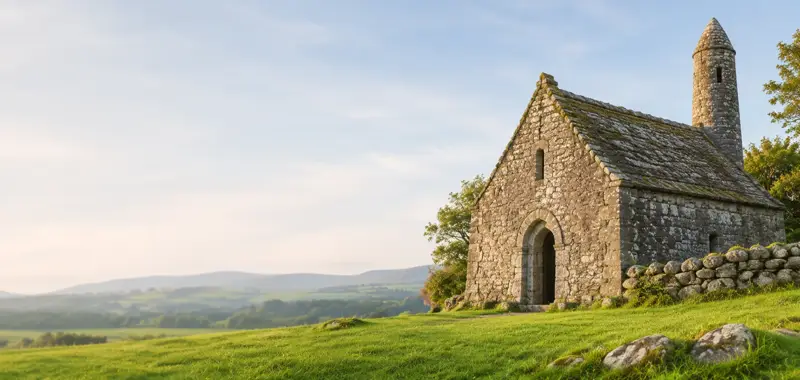
- Corcomroe Abbey is beautifully situated on the edge of the rocky hills of the Burren.
Its history
- It was founded for Cistercian monks around 1195 as a daughter house of the Abbey at Inisloughnaght, Co. Tipperary.
- The church was constructed in the early 13th century and consists of a nave with an aisle on the south side.
What you'll see
- It appears that it was intended to construct a similar aisle on the north side of the nave, but this may never have been completed, perhaps due to lack of funds.
- At the east end is a presbytery or chancel with a decorated ribbed vault lit by narrow lancet windows.
- There is a north and south transept, each with a single chapel.
- Where the presbytery and transepts meet there are several crossing arches that feature capitals with some wonderful carvings of human heads and flowers, including poppies, lily-of-the valleys and lotus.
- In the chancel is highly decorated sedilia and the effigy tomb of Conor O’Brien (d. 1268), king of the ancient territory of Thomond and descendant of the founders and benefactors of the abbey.
Text: National Monuments Service, Monuments to Visit (CC BY 4.0). Sentences grouped by topic by ErinSites; the wording is unchanged.
History and description
Full archaeological record 564 words
Listed in the RMP (1996) as ‘Abbey’. Situated in an unforgettable position amidst the stony mountains of the Burren, Corcomroe Cistercian abbey lies five miles west of Kinvara, on the S side of Galway Bay. Cultivation of the soil can never have been easy, but the spot was not as desolate as it first appears, a point appropriately made by the latin name of the abbey, Petra Fertilis. As there is no stream beside the monastery, its water supply probably came from local springs or a well. Tober Sheela (CL003-029004-) lies within the walled garden (CL003-029001-). The site was colonised from Inislounaght in 1194-5 and the founder was either Donal Mór O’Brien, king of Thomond, or his son Donough Cairbreach. The community was always small and in the later middle ages extremely poor. Although a titular abbot is named in 1628, the house had long ceased to exist as a monastic entity. In 1554 the abbey was granted to Murrough O’Brien, earl of Thomond, the site thus reverting to the same family who gave the original endowment over three hundred years before.
The church (L 40m E-W) dates from 1210 to 1225, and was planned as a reduced version of the normal Cistercian scheme, with only one chapel opening off each transept. There is an aisled nave (Wth 7m), though the roughly built arches are not arranged symmetrically north and south and there is some doubt about whether a north aisle was ever built. The E end of the building is distinguished by the high quality of its stonework – carved capitals, decorated bases, chevron and other ornament – much of it characteristic of the ‘school of the west’. The presbytery is rib-vaulted in two bays with rubble cells in curved form. The diagonals are embellished with a triple roll moulding and the transverse arch between the two bays is ornamented with deeply undercut herringbone chevron reminiscent of the Lady Chapel at Glastonbury (Stalley 1987, 135). The E gable is lit by 3 narrow lancet windows with a fourth window above and the chapel off the S transept has good evidence of wicker centring. Before work progressed beyond the transepts a serious deterioration in quality occurred, perhaps due to the famines of 1227-8. In the later medieval period the church was shortened by an inserted wall, surmounted by a bell turret, and at the same time the roofs and upper walls were extensively remodelled. Fragmentary buildings survive in the S range and there a number of featureless ruins in the outer precincts (CL003-029006-, CL003-029008-), including the remains of a gatehouse (CL003-029005-). Inside the church is a magnificent sedile, a single-arched recess with an undivided seat. The pointed arch of the sedile is decorated with a late form of chevron and it rests on robust shafts with foliate capitals; the rear wall is embellished with two blind arches, each supported on corbels. There is an effigy (CL003-029007-) of King Conor na Suidane O’Brien (d. 1267), grandson of the founder and an effigy of a bishop (CL003-029008-). There are also some incised architectural drawings on the walls and a Viking-type ship graffito in the plaster on the N wall of the chancel (Rynne 1968, 76). Corcomroe Abbey is a national monument in State care, no. 11. Roofing of the presbytery and S transept was completed by the Office of Public Works in 2006. (Stalley 1987, 244)
References
- This monument is subject to a preservation order made under the National Monuments Acts 1930 to 2014 (PO no. 1/1986).
Archaeological Survey of Ireland, National Monuments Service (CC BY 4.0) · Compiled by Mary Tunney · Updated 21 April 2015. It describes the site as it was when surveyed.
More abbeys & friaries nearby
 National Monument
Kilmacduagh monastery
Religious house - Augustinian canons · Kilmacduagh · Galway · 14 km away

Kilshanny Abbey
Religious house - Augustinian canons · Porsoon · Clare · 23 km away
 National Monument
Inchicronan Priory
Religious house - Augustinian canons · Inchicronan Island · Clare · 25 km away
 Visitor site National Monument
Claregalway Friary
Religious house - Franciscan friars · Baile Chláir · Galway · 26 km away
 National Monument
Athenry Priory
Religious house - Dominican friars · Athenry · Galway · 28 km away

Abbey of St. Mary de Portu Patrum, Annaghdown
Religious house - Augustinian canons · Eanach Dhúin · Galway · 29 km away
Visitors' notes
Badges are opinions of visitors - not verified facts. One vote per badge and visitor; no account needed.
Best time to visit
What's missing on this page?
Share a tip to find it
Share a local tradition or story
Suggest a correction
Suggest the right map location
Report a duplicate page
Ask a question
Do not include personal data. See our privacy notice.
Around Corcomroe Abbey
Other heritage nearby
- TobersheelaHoly well · 0.1 km
- Oughtmama Three ChurchesAncient church · 1.5 km
- Oughtmama ChurchAncient church · 1.5 km
- Muckinish CastleCastle · 1.8 km
- Shanmuckinish CastleCastle · 3.5 km
- Doorus Demesne wedge tombMegalithic tomb · 6.1 km
Recorded within 5 km
- 22 ringfortsArchaeological Survey of Ireland
- 6 ancient churchesArchaeological Survey of Ireland
- 5 castlesArchaeological Survey of Ireland
- 4 holy wellsArchaeological Survey of Ireland
- 4 monastic sitesArchaeological Survey of Ireland
- 3 megalithic tombsArchaeological Survey of Ireland
- 1 hillfortArchaeological Survey of Ireland
- 1 caveArchaeological Survey of Ireland
Walks and trails
- Ballyvaughan - Wood LoopWalking Trail · 8.9 km · nearest point 5.7 km
- Fanore Ballyvaughan TrekWalking Trail · 20.9 km · nearest point 6.5 km
- Carran LoopWalking Trail · 9.4 km · nearest point 7.1 km
Outdoors, towns and places to stay
- Gragan's WoodForests · 13 km
- BishopsquarterBeaches · 4.9 km · Excellent Quality (2025)
- Traught, KinvaraBeaches · 6.6 km · Excellent Quality (2025)
- Keelhilla, Slieve Carron Nature ReserveNature reserves · 5.9 km
- Ballynastaig Wood Nature ReserveNature reserves · 13 km
- Inchiquin HouseHistoric stays · 19 km
Other attractions nearby
- Burren Outdoor Education CentreNature and Wildlife · 3.1 km
- Burren WalksNature and Wildlife · 3.9 km
- Flaggy ShoreNatural Landscape · 4.3 km
- Bay SUPNature and Wildlife · 6.3 km
What's on nearby
- 4.48 Psychosis by Sarah Kane2026-11-05 · 16 km
- 4.48 Psychosis by Sarah Kane2026-11-06 · 16 km
- Romeo & Juliet, Ballet Ireland2026-11-06 · 17 km