

Unofficial guide. Not the National Monuments Service, the OPW, Fáilte Ireland or the landowner. Disclaimer
At a glance
- TypeCross - High cross
- Date or period mentioned19th century
- StatusNational Monument
What to look for
- Carved scenes
- Ring
- Base
- Inscription
Picked out from the Archaeological Survey description below.
Can you visit?
- No source says it is open to the public.Most monuments in Ireland stand on private farmland.
- Ask the landowner before crossing fields, close gates, leave the stones as you find them.Visiting responsibly
History and description
On raised ground at the base of a hill which rises to the S-SE, in rolling pasture overlooking a broad plain from NW-N. The high cross is on a hillock where there are a number of 18th and 19th century headstones. The land drops away steeply immediately S of this hillock to a small valley with St. Nicholas’s holy well (KK030-008007-) c. 10m to the S in this valley.
Full archaeological record 1,192 words
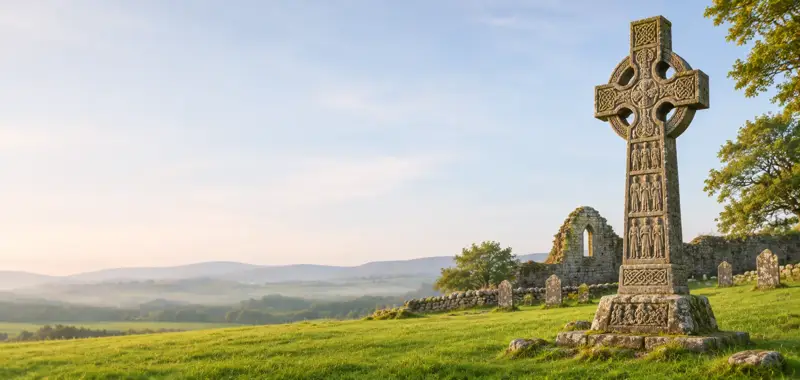
On raised ground at the base of a hill which rises to the S-SE, in rolling pasture overlooking a broad plain from NW-N. The high cross is on a hillock where there are a number of 18th and 19th century headstones. The land drops away steeply immediately S of this hillock to a small valley with St. Nicholas’s holy well (KK030-008007-) c. 10m to the S in this valley. The land rises again immediately S of this, on which rise there are the remains of a church (KK030-008003-). All these monuments are enclosed within the graveyard (KK030-008010-). According to Carrigan (1905, vol. 4, 311-2) a monastery here was founded by St. Gobán Fionn early in the 7th century whose feast day is celebrated on the 6th of December. In the Annals of the Four Masters the obit of an abbot, Domhnall son of Niall is given in 1004 (Edwards 1990, 41). Of the monastic site only a high cross (KK030-008004-), two cross-slabs (KK030-008005-; KK030-008011-), a stone cross (KK030-008013-), the remains of a church (KK030-008003-) and two bullaun stones (KK030-008006-; KK030-008008-) are currently visible at the location. The sandstone open-ringed high cross (H 2.56m; roof-cap H c. 0.3m; total H c. 2.86m; cross head max. Wth 1.16m; cross shaft Wth 0.47m; T 0.35m) stands on a two-tiered base (basal dims. 1.25m square; H 0.7m). There is a raised heavy rope-like moulding around the edges which terminates at a projecting basal plinth which is formed at the base of the shaft. There is figurative carving in the cross heads and the panels are decorated with floral and interlace patterns. Edwards (1990, 61) dates the high cross to the end of the 8th or first half of the 9th century.
The following description of the decoration is based on work by Harbison (1992, 121-4).
The E face: the cross head has a central raised boss with radiating lines. Beneath it is interlace, from each side of which emerges a serpent which stretches its head with upturned snout into the arms of the cross. There it crosses the neck of, and bites the lower jaw of, another serpent which emerges from a spiral above the central boss. On the upper arm of the cross there is an animal with body and forward-stretching legs and a head with a wide-open mouth with sharp teeth. The shaft is decorated with three patterns of marigold type, with a small three-pointed knot of interlace in the intervening spaces above and below.
The W face: the cross head has a central whorl within a circular raised moulding. Beneath which is a worn scene with a tall figure seated in the centre, with two figures, presumably angels, kneeling on its shoulders and holding an object (a crown?) above its head. The seated figure stretches out his left arm so that the hand is placed on the head of a small winged figure in the bottom right hand corner. Through comparison with a mosaic in St. Mark’s in Venice this has been interpreted as God blessing and sanctifying the seventh day of creation. The N arm shows a horseman hunting a stag with a dog on its back, the S arm shows a chariot procession with a man with a crook or crozier on or above the horse and a number of human figures in front. Above the whorl a seated figure with bare legs on the left appears to hold up a small creature on its knees and is approached by a figure from the right, possibly holding a stick. Harbison suggest this represents Eve holding up one of her children and Adam tilling the soil after they have been expelled from paradise. The upper arm is decorated with interlinked chains. The shaft contains two main panels, the upper consisting of vertically structured fretwork with diagonal lines interspersed, the lower larger panel consists of diagonal fretwork. The basal plinth is very worn but according to Macalister it bears an inscription, ‘ÓR DO MAELSECHNAILL’, which translates as ‘Prayer for Maelsechnall’.
The N side: Vertical ribs divide the shaft into three upright panels. The central panel has broad interlace which continues in a slightly different form under the ring and reverts to the original pattern for the upper arm. The end of the arm is divided into four panels. The top left depicts two embracing figures which may represent Christ and John the Baptist embracing in the desert or Jacob wrestling with an angel. The top right shows a central figure holding out an object towards the right and a figure on the left which has been interpreted as Salome with Herodias in the centre with the head of John the Baptist or The Temptation of St. Anthony or David killing the lion/Death of Goliath or. The bottom left depicts two figures holding up a large upright object between them, which if related to John the Baptist, may represent the tablet on which Zacharias writes the name John. Another interpretation is Paul and Anthony receiving bread in the desert. The bottom right shows two figures facing forward, that on the left seeming to hold a child, possibly Elisabeth and Zacharias with the infant John the Baptist.
The S side: Vertical mouldings on the shaft divide it into three upright panels, the central one having simple broad-banded interlace which turns into running spirals under the arm but reverts to interlace for the top of the upper arm. The basal plinth has a roundel decorated with interlace. The end of the arm depicts Noah’s Ark as a semi-circular hull, a steering oar on the right and four figures below deck. Above the deck there is a dove with very large claws, probably holding an olive-branch in its mouth.
The base of the high cross:
The E side: The lower level is decorated on the E side with rows of steeped crosses with sunken centres and the upper is very worn but in the left-hand half there would appear to be a man sticking out his arm in the midst of birds and other animals.
The W side: The lower level is divided into a number of panels, of which that in the centre has two crosses in false relief sharing one common arm, and bearing lozenge-shaped or spiral decoration. To the left is a panel of interlace forming a cross with four triangular arms, while at the extreme right-hand end there is a panel of interlace forming a cross-shape. The panel on the extreme left has interlinked squares with sunken centres. The upper level has three groups of two bosses, probably with spiral and trumpet decoration between them.
The N side: The lower level has a stepped pattern in relief, probably with geometrical decoration in the background. The upper level has no apparent decoration.
The S side: The lower level is divided into three separate panels, that on the left with a broad interlace, the other two are too worn to discern. The upper level is badly weathered but seems to have on the left a cross-shaped panel possibly bearing a human interlace surrounding a sunken cross within it, and on the right perhaps interlace motifs.
Archaeological Survey of Ireland, National Monuments Service (CC BY 4.0) · Compiled by Jean Farrelly · Updated 26 July 2017. It describes the site as it was when surveyed.
Folklore and traditions
More high crosses nearby
 National Monument
Ahenny High Crosses
Cross - High cross · Ahenny · Tipperary · 7.8 km away
 National Monument
Kilkieran High Crosses
Cross - High cross · Castletown (Iverk By) · Kilkenny · 9.7 km away

Kilree High Cross
Cross - High cross · Kilree (Kells By.) · Kilkenny · 13 km away
Leggetsrath East High Cross
Cross - High cross · Leggetsrath East · Kilkenny · 25 km away
Also recorded nearby
Named sites within 5 km with only a short entry in the Archaeological Survey.
- TobernagloghlinRitual site - holy well · Kiltrassy · 4.6 km · official record
- Church WellRitual site - holy well · Oldcastle Lower · 4.8 km · official record
Visitors' notes
Badges are opinions of visitors - not verified facts. One vote per badge and visitor; no account needed.
Best time to visit
What's missing on this page?
Share a tip to find it
Share a local tradition or story
Suggest a correction
Suggest the right map location
Report a duplicate page
Ask a question
Do not include personal data. See our privacy notice.
Around Killamery High Cross
Other heritage nearby
- St. Nicholas's Well (Killamery)Holy well · 0.0 km
- Rossaneny Graveyard and Church ruinAncient church · 3.4 km
- Ballinvir Standing StoneStanding stone · 5.1 km
- St Mary's WellHoly well · 5.1 km
- Knockroe Passage TombMegalithic tomb · 5.8 km
- ToberbrideHoly well · 6.5 km
Recorded within 5 km
- 12 ringfortsArchaeological Survey of Ireland
- 7 ancient churchesArchaeological Survey of Ireland
- 5 castlesArchaeological Survey of Ireland
- 3 holy wellsArchaeological Survey of Ireland
- 1 monastic siteArchaeological Survey of Ireland
- 1 megalithic tombArchaeological Survey of Ireland
Walks and trails
- Windgap - Bearna Breac LoopWalking Trail · 6.6 km · nearest point 0.8 km
- Windgap - Village LoopWalking Trail · 1.8 km · nearest point 3.4 km
- Tullahought - Kilmacoliver Summit LoopWalking Trail · 3.8 km · nearest point 8.4 km
Outdoors, towns and places to stay
- CastlemorrisForests · 12 km
- Garryricken Nature ReserveNature reserves · 3.2 km
- Kyleadohir Nature ReserveNature reserves · 6.4 km
- CallanWalled towns · 8.5 km
- Carrick-on-SuirWalled towns · 15 km
Other attractions nearby
- Walk With WalterWalking · 1.5 km
- Knockroe Passage TombHistoric Houses and Castle · 5.8 km
- Ahenny High CrossesHistoric Houses and Castle · 7.8 km
- Edmund Rice Heritage CentreHistoric Houses and Castle · 9.2 km