


Unofficial guide. Not the National Monuments Service, the OPW, Fáilte Ireland or the landowner. Disclaimer
At a glance
- TypeRitual site - holy well
- Date or period mentioned19th-century
- Recorded sizeW 0.65m, D 0.2m
What to look for
- Offerings left
- Cross or cross-slab
- Pattern day
Picked out from the Archaeological Survey description below.
Can you visit?
- No source says it is open to the public.Most monuments in Ireland stand on private farmland.
- Ask the landowner before crossing fields, close gates, leave the stones as you find them.Visiting responsibly
History and description
Annotated St. Columkille's Well on the 1863 ed. OSi 25-inch map. This is a well maintained holy well in the parish of Tallaght that is dedicated to St. Columcille.
Full archaeological record 655 words
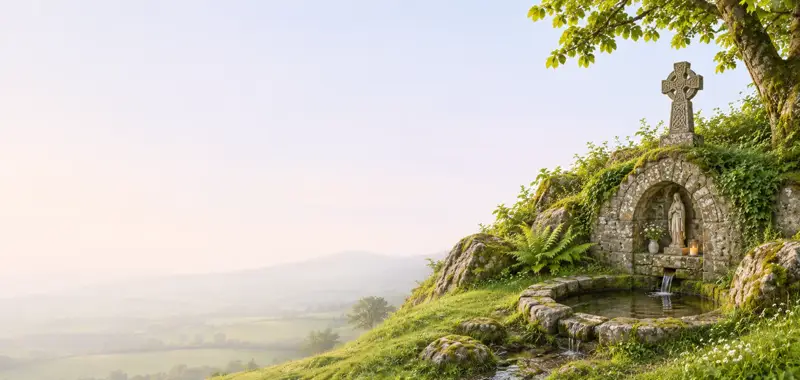
Annotated St. Columkille's Well on the 1863 ed. OSi 25-inch map. This is a well maintained holy well in the parish of Tallaght that is dedicated to St. Columcille. The water is traditionally thought to cure sore eyes, ears and throat. It is a natural spring which has been enclosed, with a granite basin that contains a spout-like feature (Wth 0.65m, D 0.2m). It is still venerated. The holy well was described by Handcock (1877, 43) as follows; 'Near Orlagh gate, about one hundred yards from the road, in a field on the west side of Mount Venus, is a well dedicated to St. Columbkill. There are some very old thorn trees round it, which used to he covered with rags, ribbons, and garlands, the votive offerings of those who came to drink of the water. Beside the well is a large granite rock, in which is the deeply-marked impression of the knee of the saint as he kneeled to drink. It is said that the water of this well cannot be made to boil ( I never tried). In the field, near the well, stands a large plain granite cross, erected with several others, some of granite, more of wood, to secure immunity from the cattle plague, about 1849'. In the 1958 the well was described by Ó Danachair (1958, 86) as follows; 'A clear spring with a little runlet of water. It is a very ancient looking thing - OSL. Now enclosed in a cupola of masonry and embellished with a crucifix, a statue of the saint, a railing, paths and shrubs ; there is a chained metal cup for drinking. Still visited; the water is drunk and applied to sore eyes, cars and throat. The pilgrim recites a rosary at the well. In recent years the Sunday after 9th June is a day of devotion, with public prayers and hymns. Small religious objects are left as offerings, as are flowers. Some crutches have been left by people cured there and many medals are nailed to a tree which overhangs the well. Legend: the water cannot boil'. A stream runs below the well. A 19th-century stone cross stands 60m to the NE, and is marked on the historic OSi maps (Herity 2001, 37).
Folklore collected from Edmondstown School recorded the following tradition about St. Columcille's Well; 'This well is situated near Orlagh College. Many people visit it in the Summer. The people leave medals, scapulars, and Rosary beads, and prayer books when they visit it. Many people get cured of sickness by visiting it. There is a statue of St Columcille beside the well' (The Schools’ Collection, Volume 0797, Page 27; https://www.duchas.ie/en/cbes/4428229/4387497/4458590).
Folklore collected from St. Mary's School, Tallaght recorded the following story about the origins of the well; 'St Columcille's Well at Ballycullen is situated at the foot of the Dublin Hills in a clump of trees close to the entrance to Orlagh College. It is told that one very hot summer's day St Columcille was journeying from his school at Drumcondra to visit another of his schools in Wicklow. He took the shortest way across the Dublin Mountains. Being tired and thirsty he stopped a while to rest. Finding a well, he drank of the water, and then having washed and rested he went on his way, blessing the well before he departed. The imprint of the Saint's knees are still shown on a rock at the well and numerous "cures" have been effected by the use of the water. The well has never been known to go "dry" even in the most sultry summer. During the Great War a pilgrimage was organized to this well to beg the Saint's intercession to avert "Conscription" in Ireland.
A fete or Feis or Pattern was also organized to raise funds to build a shrine and erect a bridge over the stream which drains the well' (The Schools’ Collection, Volume 0795, Page 041; https://www.duchas.ie/en/cbes/4428219/4386865/4456593).
References
- Date of revised upload: 20 April 2023
Archaeological Survey of Ireland, National Monuments Service (CC BY 4.0) · Compiled by Geraldine Stout. It describes the site as it was when surveyed.
Folklore and traditions
The water is traditionally thought to cure sore eyes, ears and throat.
There are some very old thorn trees round it, which used to he covered with rags, ribbons, and garlands, the votive offerings of those who came to drink of the water.
Small religious objects are left as offerings, as are flowers.
Some crutches have been left by people cured there and many medals are nailed to a tree which overhangs the well.
Legend: the water cannot boil'.
Folklore collected from Edmondstown School recorded the following tradition about St. Columcille's Well; 'This well is situated near Orlagh College.
More holy wells nearby
St. Brigid's Well
Ritual site - holy well · Dublin · 5.4 km away
St. Bridget's Well
Ritual site - holy well · Brideswell Commons · Dublin · 7.0 km away
Lady Well
Ritual site - holy well · Dublin · 9.1 km away

St Patrick's Well
Ritual site - holy well · Dublin · 9.6 km away

St Winifred’s Well
Ritual site - holy well · Dublin · 9.6 km away
St. Bridget's Well
Ritual site - holy well · Rathcoole · Dublin · 9.8 km away
Visitors' notes
Badges are opinions of visitors - not verified facts. One vote per badge and visitor; no account needed.
Best time to visit
What's missing on this page?
Share a tip to find it
Share a local tradition or story
Suggest a correction
Suggest the right map location
Report a duplicate page
Ask a question
Do not include personal data. See our privacy notice.
Around St Colmcille's Well
Other heritage nearby
- Kilmashogue Megalithic TombMegalithic tomb · 3.6 km
- Rathfarnham CastleCastle · 4.4 km
- Old St Mary's Church, CrumlinAncient church · 6.2 km
- Drimnagh CastleCastle · 6.4 km
- Kilgobbin CrossHigh cross · 7.4 km
- Clondalkin Round TowerRound tower · 7.6 km
Recorded within 5 km
- 11 ancient churchesArchaeological Survey of Ireland
- 9 megalithic tombsArchaeological Survey of Ireland
- 8 castlesArchaeological Survey of Ireland
- 6 monastic sitesArchaeological Survey of Ireland
- 5 holy wellsArchaeological Survey of Ireland
- 4 ringfortsArchaeological Survey of Ireland
- 1 standing stoneArchaeological Survey of Ireland
Walks and trails
- Massey's Estate - Nature trailWalking Trail · 2.6 km · nearest point 1.6 km
- Dublin Mountains WayLong Distance Waymarked Way · 41.2 km · nearest point 2.8 km
- Cruagh - Sli na SlainteWalking Trail · 3.7 km · nearest point 3.0 km
Outdoors, towns and places to stay
- Hell Fire ClubForests · 1.7 km
- Massy's EstateForests · 1.8 km
- Merrion StrandBeaches · 9.8 km
- Sandymount StrandBeaches · 10 km · Sufficient Quality (2025)
- Knocksink Wood Nature ReserveNature reserves · 12 km
- North Bull Island Nature ReserveNature reserves · 16 km
- TallaghtWalled towns · 3.2 km
- CrumlinWalled towns · 6.5 km
- Merrion MewsHistoric stays · 9.3 km
- Georgian TownhouseHistoric stays · 9.5 km
Other attractions nearby
- Sean Walsh Memorial ParkNature and Wildlife · 3.2 km
- Pearse Museum - St. Enda's ParkMuseums and Attraction · 3.5 km
- Marlay ParkNature and Wildlife · 3.5 km
- Marlay DemesneNature and Wildlife · 3.7 km
What's on nearby
- The Uncertainty Principle as part of NEWvember 20262026-11-05 · 3.8 km · free
- Rhythm Of my Heart / The Rod Stewart Songbook2026-11-05 · 3.8 km
- Caith Amach É 20262026-11-05 · 3.8 km
Excavations nearby
- 06E227 Sandyford to Cherrywood Extension, Murphystown, County DublinRoad-scheme excavation report (TII) · 7.8 km