


Unofficial guide. Not the National Monuments Service, the OPW, Fáilte Ireland or the landowner. Disclaimer
At a glance
- TypeRitual site - holy well
Picked out from the Archaeological Survey description below.
Can you visit?
- No source says it is open to the public.Most monuments in Ireland stand on private farmland.
- Ask the landowner before crossing fields, close gates, leave the stones as you find them.Visiting responsibly
History and description
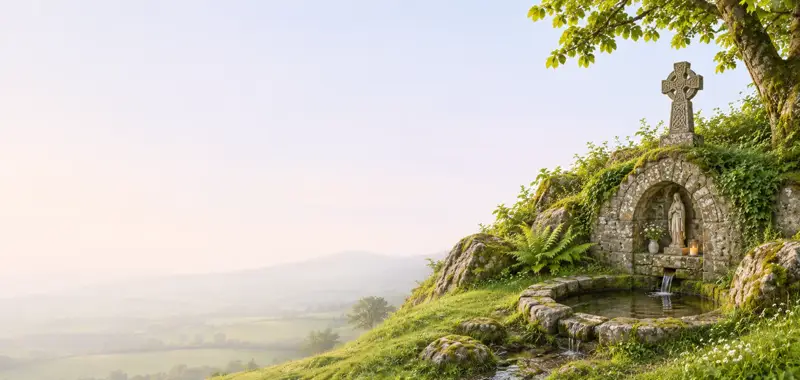
Located on the side entrance into St. Catherine's Park. There are two wells side by side, with arched coverings.
Full archaeological record 748 words
Located on the side entrance into St. Catherine's Park. There are two wells side by side, with arched coverings. This one is higher than the other (DU017-002002-). Tradition has it that the water from the larger well was drunk and the water from the smaller well was used to bathe sore eyes. Joyce described the wells as being canopied, the larger having a wooden door and a stone head (1912, 359). In 1958 the stone head fixed to the higher arch had been stolen more than once (Ó Danachair 1958, 82). This has since been removed and the well hood vandalised. No longer venerated.
Folklore collected from Palmerstown School recorded the following details about St Catherine's Wells; 'There are two wells beside each other in a farm called St. Catherine's now owned by Mr. McMahon. The two wells are connected. The water of one flows into the other. It is said that the two are holy wells and are named St. Catherine's Wells. Mr. McMahon told me that the well to the right is the Holy Well and that the other well is not. Over the well at the right there is the model of a head. It is said that it represents St. Catherine.
The waters are believed to have the virtue of curing sore eyes. People used to come there to pray and to wash their eyes with the water. I don't know if they left rags or other articles after them at the well or not.
The water of the well to the left are used for many purposed but the waters of the other well are never used. Those who pass by stop at the this well and drink a little of the water, and perhaps pray there' (The Schools’ Collection, Volume 0795, Pages 101d-f; https://www.duchas.ie/en/cbes/4428221/4386928).
Folklore collected in 1937 from Lucan Presentation Convent recorded the following tradition about this well; 'St. Catherines's Well between Lucan and Leixlip is a very ancient Well. It is said that a man wished to bring it to his house with pipes. He asked the priest. If he would give him leave to do so. The priest said he could not that if he did he would never get the water hot. But the man did as he liked he put the pipes from it but he could never get the water warm no matter how much fuel he put on the fire' (The Schools’ Collection, Volume 0794, Pages 38-9).
A second story collected from the same school recorded that; 'In the western side of Lucan is the famous St. Catherine's. There is a well still here called St. Catherine's Well. Was it one of the holy wells of Ireland? A bust of the Saint is all that is left to tell the tale. Many a poor villager have I known to make a pilgrimage there and with its waters to bathe the weak eyes, the deaf ears, and the languid limbs. In the year 1219 the Canons of the Congregation of St. Victor took possession of the hallowed spot. Warrisius de Peche gave the site. It was he who built the Church of the Blessed Mary of Lucan, and it was to this community he left it in charge; and there they prayed and laboured with ceaseless zeal for the temporal and eternal weal of the people of Lucan. The Lord of Leixlip, Sir Adam de Hereford, assigned then lands in Leixlip, on the condition they would pray for the repose of the souls of his forefathers' (The Schools’ Collection, Volume 0794, Pages 39-40; https://www.duchas.ie/en/cbes/4428213/4386676).
Folklore collected from Lucan School in 1937 recorded that; 'In the northern end of Lucan parish about a half mile from the Liffey and about three quarters of a mile away from Leixlip, there are two wells one of which is called St Catherine's Well. One is a large one and the other is a small one; the water of the small one has a cure for sore eyes. About a furlong away from the wells are the ruins of an old convent. It is said that in olden times that St Catherine was taken from the convent and was slain where the wells are now. It is also said that these wells came from where the blood lodged when she was killed, and above another furlong away from the well there are the ruins of an old chapel, ghosts are seen her frequently' (The Schools’ Collection, Volume 0794, Pages 307-8; https://www.duchas.ie/en/cbes/4428214/4386574)
References
- Date of revised upload: 17 April 2023
Archaeological Survey of Ireland, National Monuments Service (CC BY 4.0) · Compiled by Geraldine Stout. It describes the site as it was when surveyed.
Folklore and traditions
Tradition has it that the water from the larger well was drunk and the water from the smaller well was used to bathe sore eyes.
Folklore collected from Palmerstown School recorded the following details about St Catherine's Wells; 'There are two wells beside each other in a farm called St. Catherine's now owned by Mr. McMahon.
The waters are believed to have the virtue of curing sore eyes.
I don't know if they left rags or other articles after them at the well or not.
Folklore collected in 1937 from Lucan Presentation Convent recorded the following tradition about this well; 'St. Catherines's Well between Lucan and Leixlip is a very ancient Well.
Folklore collected from Lucan School in 1937 recorded that; 'In the northern end of Lucan parish about a half mile from the Liffey and about three quarters of a mile away from Leixlip, there are two wells one of which is called St Catherine's Well.
More holy wells nearby
St Catherines Park Holy Well
Ritual site - holy well · St. Catherine'S Park · Dublin · 0.0 km away

Our Ladys Well
Ritual site - holy well · Tyrrelstown · Dublin · 7.1 km away
St. Bridget's Well
Ritual site - holy well · Castleknock (Without Phoenix Park) · Dublin · 7.3 km away
St. Bridget's Well
Ritual site - holy well · Brideswell Commons · Dublin · 7.7 km away
St. Bridget's Well
Ritual site - holy well · Rathcoole · Dublin · 9.4 km away
St. Catherine's Well
Ritual site - holy well · Crockshane · Dublin · 11 km away
Visitors' notes
Badges are opinions of visitors - not verified facts. One vote per badge and visitor; no account needed.
Best time to visit
What's missing on this page?
Share a tip to find it
Share a local tradition or story
Suggest a correction
Suggest the right map location
Report a duplicate page
Ask a question
Do not include personal data. See our privacy notice.
Around St Catherine's Holy Well (Dublin)
Other heritage nearby
- St Catherine's Park ChurchAncient church · 0.2 km
- Leixlip CastleCastle · 1.3 km
- Castletown HouseCastle · 4.4 km
- Corduff FortRingfort · 7.0 km
- Clondalkin Round TowerRound tower · 7.2 km
- St Finian's Church of IrelandAncient church · 7.7 km
Recorded within 5 km
- 15 castlesArchaeological Survey of Ireland
- 12 ancient churchesArchaeological Survey of Ireland
- 7 holy wellsArchaeological Survey of Ireland
- 6 ringfortsArchaeological Survey of Ireland
- 3 monastic sitesArchaeological Survey of Ireland
- 1 abbey or friaryArchaeological Survey of Ireland
- 1 standing stoneArchaeological Survey of Ireland
Walks and trails
- Royal Canal Greenway - Drumcondra - Ashtown - CastleknockGreenway · 8.9 km · nearest point 7.3 km
- Royal Canal Greenway - Drumcondra - Ashtown - CastleknockGreenway · 8.9 km · nearest point 7.3 km
- Royal Canal Greenway Cycling TrailGreenway · 121.4 km · nearest point 7.9 km
Outdoors, towns and places to stay
- Slievethoul and LuggForests · 13 km
- Sandymount StrandBeaches · 18 km · Sufficient Quality (2025)
- Merrion StrandBeaches · 19 km
- CrumlinWalled towns · 11 km
- TallaghtWalled towns · 11 km
- Batty Langley LodgeHistoric stays · 3.7 km
- Castletown Gate HouseHistoric stays · 5.1 km
Other attractions nearby
- St Mary's Church LeixlipHistoric Houses and Castle · 1.2 km
- Leixlip CastleHistoric Houses and Castle · 1.3 km
- Dublin FalconryNature and Wildlife · 3.6 km
- Arthur’s Way Heritage TrailWalking · 5.2 km
What's on nearby
- Dublin Gallery Weekend 20262026-11-05 · 11 km · free
- The Uncertainty Principle as part of NEWvember 20262026-11-05 · 11 km · free
- Rhythm Of my Heart / The Rod Stewart Songbook2026-11-05 · 11 km
Excavations nearby
- E2032 Fonthill, Lucan and Pettycannon, County DublinRoad-scheme excavation report (TII) · 2.0 km
- 01E1225 site 18 Collinstown, County KildareRoad-scheme excavation report (TII) · 3.2 km