


Unofficial guide. Not the National Monuments Service, the OPW, Fáilte Ireland or the landowner. Disclaimer
At a glance
- TypeRitual site - holy well
- Condition (as surveyed)Ruined
What to look for
- Well house
- Offerings left
- Steps down
- Cross or cross-slab
- Pattern day
Picked out from the Archaeological Survey description below.
Can you visit?
- No source says it is open to the public.Most monuments in Ireland stand on private farmland.
- Ask the landowner before crossing fields, close gates, leave the stones as you find them.Visiting responsibly
History and description
Annotated 'Lady's Well' on the 1837 ed. OSi 6-inch map, Mulhuddart church ruins (DU013-010001-) and graveyard (DU013-010001-) 270m to NNE. Dedicated to the Blessed Virgin Mary.
Full archaeological record 870 words
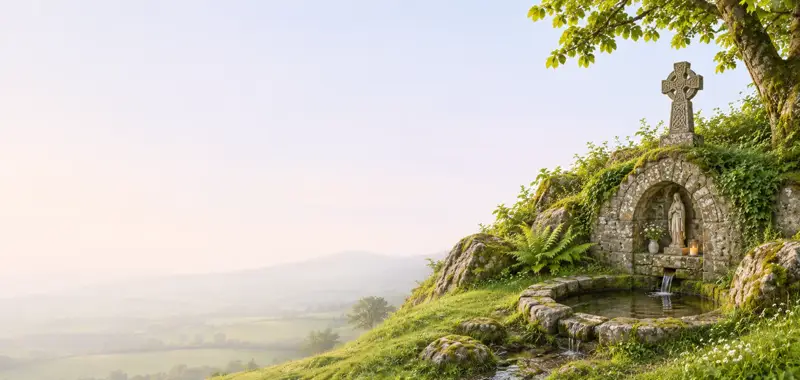
Annotated 'Lady's Well' on the 1837 ed. OSi 6-inch map, Mulhuddart church ruins (DU013-010001-) and graveyard (DU013-010001-) 270m to NNE. Dedicated to the Blessed Virgin Mary. This vaulted well-house stands by the roadside which marks the townland boundary with Buzzardstown to the E. The well is approached by stone steps. On the roof are two finials, one a stone carved with a cross in relief and the other a stone niche with an inscription. It is still venerated. Formerly a pattern day was held on the 8th of September (Ó Danachair 1958-60, 76; Daly 1957, 19). The water is traditionally reputed to cure sprains, cuts, bruises and rheumatism. The well is recognised by Fingal County Council as a 'County Geological Site' (Parkes 2012, 52).
Around 1740 Isaac Butler wrote the following description of this holy well in his account of 'A Journey from Dublin to the Shores of Lough Derg'; 'About midway, ascending to ye church, is an excellent well. It is carefully walled in, and several large trees about it. Here, on the 8th September, a great pattern is kept with a vast concourse of all sexes and ages from many miles, upwards of eighty tents being pitched here, furnished with all kinds of liquors and provisions for ye refreshment of ye company'. The vaulted structure was described in 1897 as; 'On the north is a square-headed opening, which gives light to the interior of the back, and over it is a niche and cross cut in relief on a square block of stone; in the south gable there is also a niche' (Anon. 1897, 448).
Folklore collected from Mulhuddart School recorded the following traditions about 'The Lady Well'; 'Situated about a half mile north of the village and about three hundred yards south of the old church. Over the well there is an erection made of stone in shape of a little chapel. There are several cures in the waters of the well. Rheumatism and sore eyes are the principal sicknesses which is cured with the waters. I have been in conversation with a man who has been cured from blindness with the water. He visited the well nine times each being on the first friday of the month. At each visit he recited the rosary and washed his eyes with the water. During the time his sight was gradually restored to him. When he had completed his visits he could see again. This man had great belief in the waters of the well. When he had been cured he placed a statue of Our Blessed lady and a small oil lamp there.
Another man named Mr Lyster of Stoneybatter was cured with the waters. He was suffering from Rheumatism. He took home some water from the well and rubbed a portion of the water on the aching spot one a day. During the time he prayed to the Blessed Virgin. After some time the Rheumatism was cured.
On some sunday evenings people come and visit the well.
One sunday evening Mr Delaney and his family paid a visit to the well. There was broken glass strewn around the well and the visitors walked around the well barefooted. During the rounds they were reciting the rosary. Sometimes one of them would kneel in front of the well for a time. It is said that Miss Ellen Carr told Mr Delaney to do this and it would cure his pains which he frequently suffered from. Some people come to the well and drink the waters for the good of their health.
Long ago there was a pattern held at the well. Priests and monks used to visit the well on Pattern Day and devotions were held. Dealers erected camp in the fields around the well land sold drink and refreshments there. Owing to the conduct carried on there by the people the pattern had to be stopped.
The late Mr Byrne of Powerstown returning home one night looked behind him after he had passed the well. On the centre of the road right opposite the well he saw a vision kneeling down. He turned round and travelled home as fast as he could.
There is a legend concerning the well. It is said that the Blessed Well once stood on the opposite side of the road to where it is now. But there were some men returning from work and filled it in. Immediately they had finished the work the well sprung up on the opposite side of the road.
Prayer on Lady Well.
The prayer inscribed on the Lady Well is as follows;
O Blessed Mother and Ever Virgin
Glorious Queen of the World
Make Into mo mon For -------
Vouch safe that I may
Praise Thee O Sacred Virgin
O Bl in for me [?]
A gain thy Ever.
On the top of the stone section there is a stone water font and the prayer is inscribed on each side of the little erection. Some of the stone has been weather-beaten and the part of the prayer is difficult to read' (The Schools’ Collection, Volume 0790, Pages 68-71; https://www.duchas.ie/en/cbes/4498605/4385353).
Anon. 1897 Proceedings: Excursions in County Dublin. Journal of the Royal Society of Antiquaries of Ireland 27, 446-59.
References
- Date of revised upload: 14 April 2023
Archaeological Survey of Ireland, National Monuments Service (CC BY 4.0) · Compiled by Geraldine Stout, Paul Walsh. It describes the site as it was when surveyed.
Folklore and traditions
Formerly a pattern day was held on the 8th of September (Ó Danachair 1958-60, 76; Daly 1957, 19).
The water is traditionally reputed to cure sprains, cuts, bruises and rheumatism.
Here, on the 8th September, a great pattern is kept with a vast concourse of all sexes and ages from many miles, upwards of eighty tents being pitched here, furnished with all kinds of liquors and provisions for ye refreshment of ye company'.
Folklore collected from Mulhuddart School recorded the following traditions about 'The Lady Well'; 'Situated about a half mile north of the village and about three hundred yards south of the old church.
There are several cures in the waters of the well.
Rheumatism and sore eyes are the principal sicknesses which is cured with the waters.
More holy wells nearby
St. Bridget's Well
Ritual site - holy well · Castleknock (Without Phoenix Park) · Dublin · 4.4 km away
St Brigid's Well
Ritual site - holy well · Ward Lower · Dublin · 4.5 km away

St Patrick's Well
Ritual site - holy well · Dublin · 6.2 km away
St. Margaret's Well
Ritual site - holy well · St. Margaret'S · Dublin · 6.4 km away

St Catherine's Holy Well (Dublin)
Ritual site - holy well · St. Catherine'S Park · Dublin · 7.1 km away
St Catherines Park Holy Well
Ritual site - holy well · St. Catherine'S Park · Dublin · 7.1 km away
Visitors' notes
Badges are opinions of visitors - not verified facts. One vote per badge and visitor; no account needed.
Best time to visit
What's missing on this page?
Share a tip to find it
Share a local tradition or story
Suggest a correction
Suggest the right map location
Report a duplicate page
Ask a question
Do not include personal data. See our privacy notice.
Around Our Ladys Well
Other heritage nearby
- Corduff FortRingfort · 1.4 km
- Ward Lower ChurchAncient church · 4.7 km
- Dunsoghly CastleCastle · 5.3 km
- Ashtown CastleCastle · 6.2 km
- St Margaret's ChurchAncient church · 6.7 km
- St Catherine's Park ChurchAncient church · 7.2 km
Recorded within 5 km
- 11 ancient churchesArchaeological Survey of Ireland
- 6 ringfortsArchaeological Survey of Ireland
- 6 holy wellsArchaeological Survey of Ireland
- 6 castlesArchaeological Survey of Ireland
- 1 monastic siteArchaeological Survey of Ireland
- 1 abbey or friaryArchaeological Survey of Ireland
Walks and trails
- Royal Canal Greenway - Drumcondra - Ashtown - CastleknockGreenway · 8.9 km · nearest point 3.4 km
- Royal Canal Greenway - Drumcondra - Ashtown - CastleknockGreenway · 8.9 km · nearest point 3.4 km
- Royal Canal Greenway Cycling TrailGreenway · 121.4 km · nearest point 12 km
Outdoors, towns and places to stay
- Sandymount StrandBeaches · 15 km · Sufficient Quality (2025)
- Shelley BanksBeaches · 16 km
- North Bull Island Nature ReserveNature reserves · 18 km
- North Bull Island Nature ReserveNature reserves · 18 km
- CrumlinWalled towns · 10 km
- DublinWalled towns · 11 km
- Batty Langley LodgeHistoric stays · 11 km
- Georgian TownhouseHistoric stays · 11 km
Other attractions nearby
- Tolka Valley ParkNature and Wildlife · 1.6 km
- Dublin FalconryNature and Wildlife · 3.8 km
- Farmleigh House and EstateHistoric Houses and Castle · 5.3 km
- Phoenix Park Visitor Centre - Ashtown CastleHistoric Houses and Castle · 6.2 km
What's on nearby
- Dublin Gallery Weekend 20262026-11-05 · 7.4 km · free
- Scummy Mummies - Hot Mess2026-11-05 · 9.1 km
- Roe & Co Irish Coffee Experience2026-11-05 · 10 km
Excavations nearby
- 03E1360 Cherryhound Site 2, County DublinRoad-scheme excavation report (TII) · 4.0 km
- 03E1358 Ward Upr Site 6, County DublinRoad-scheme excavation report (TII) · 4.2 km