

Unofficial guide. Not the National Monuments Service, the OPW, Fáilte Ireland or the landowner. Disclaimer
At a glance
- TypeCross - High cross
- Date or period mentioned12th-century
- Recorded sizeH 1.54m; W 1.25m
- StatusNational Monument
What to look for
- Carved scenes
- Ring
- Base
Picked out from the Archaeological Survey description below.
Can you visit?
- No source says it is open to the public.Most monuments in Ireland stand on private farmland.
- Ask the landowner before crossing fields, close gates, leave the stones as you find them.Visiting responsibly
History and description
In the graveyard of Ullard 12th-century church (KK025-038001-) and graveyard (KK025-038009-), located immediately SE of a handball alley which was built onto the E end of the church. The church is dedicated to St Fiachra, who according to tradition founded it in the latter part of the 6th-century (Vigors 1893, 257).
Full archaeological record 620 words
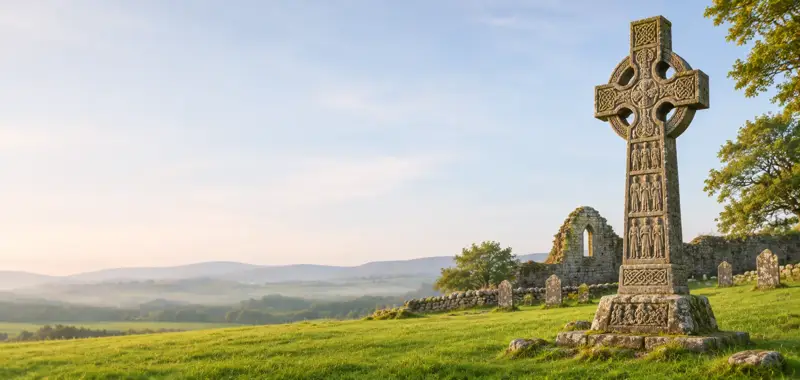
In the graveyard of Ullard 12th-century church (KK025-038001-) and graveyard (KK025-038009-), located immediately SE of a handball alley which was built onto the E end of the church. The church is dedicated to St Fiachra, who according to tradition founded it in the latter part of the 6th-century (Vigors 1893, 257). Three separate fragments of a granite cross, a cross base, a cross-head (H 1.54m; Wth 1.25m) with the top of the shaft (Wth 0.35m; T 0.29m) and the lower part of a cross-shaft (H 0.93m; Wth 0.45m; T 0.36m), have been mounted together to form this high cross. The middle portion of the shaft is formed from modern cement. Though currently facing SE-NW, Harbison (1992, 183-4) describes the SE face as E and the NW face as W. As described by Harbison, the cross-head has an imperforate ring, with slender roll-mouldings around the edges of both the cross and ring. The head narrows in thickness towards the top. The E and W facing segments of the ring were probably decorated but most this is worn, apart from spiral ornament on the lower left-hand segment on the E face. The sides of the cross are not decorated, nor is the cross base, apart from the E face. The E face of the cross base is divided into three horizontal bands. Both upper two bands are divided into two panels, these are quite worn, though interlace decoration is discernible. The lower band is divided into three panels, the left has a knot of interlace, the centre has four interlinked knots of interlace and the right has a four-legged spiral with ‘nail-head’ in-fills. The lowest panel on the E face of the shaft is decorated with six figures, presumably Apostles, shown frontally three over three. The E face of the cross head is centrally decorated with the Crucifixion, a large figure of Christ with arms outstretched, with two smaller figures beneath the arms, representing Longinus on the left, piercing Christ’s armpit with an upright lance and Stephaton, on the right, offering vinegar at the end of a pole. There is an angel above each of Christ’s shoulders. The uppermost cross arm has a panel with two figures, one possibly holding a sword and the other a shield, interpreted as David and Goliath. The S arm has a panel with a figure, David, on a chair playing a harp which rests on his knee. The N arm has a panel depicting Abraham holding up his sword over Isaac who is crouching on an altar. The lower arm has a panel showing Adam and Eve facing each other with an arm outstretched, probably exchanging an apple from the apple tree between them, its fruit laden branches spreading out over each figure. The central panel on the W face is very worn. Harbison describes two figures seated opposite each other and suggests these may be Paul and Anthony holding the bread between them with, possibly, a bird flying above them. The uppermost cross arm has a panel depicting three figures, two upright with a third upside-down between them. There have been several suggested interpretations for this panel including The Slaughter of the Innocents, The Judgement of Solomon and Saints Paul and Anthony overcoming the devil in human form or one or other of these saints being held upside-down by demons. The S arm depicts The Temptation of St Anthony, the saint being shown in the centre flanked on each side by a demon with a human body and animal head. The panel on the N arm depicts two figures, the rightmost figure appears to be thrusting a long stick into the head of the other figure. (Harbison 1992, vol. 1, 183-4; vol. 2, figs, 642-4).
Archaeological Survey of Ireland, National Monuments Service (CC BY 4.0) · Compiled by Jean Farrelly · Updated 14 February 2017. It describes the site as it was when surveyed.
Folklore and traditions
The church is dedicated to St Fiachra, who according to tradition founded it in the latter part of the 6th-century (Vigors 1893, 257).
The E face of the cross head is centrally decorated with the Crucifixion, a large figure of Christ with arms outstretched, with two smaller figures beneath the arms, representing Longinus on the left, piercing Christ’s armpit with an upright lance and Stephaton, on the right, offering vinegar at the end of a pole.
More high crosses nearby
 National Monument
Lorum High Cross
Cross - High cross · Lorum · Carlow · 9.3 km away
 National Monument
Nurney Cross
Cross - High cross · Nurney · Carlow · 19 km away
Leggetsrath East High Cross
Cross - High cross · Leggetsrath East · Kilkenny · 20 km away

Kilree High Cross
Cross - High cross · Kilree (Kells By.) · Kilkenny · 24 km away
Also recorded nearby
Named sites within 5 km with only a short entry in the Archaeological Survey.
- TobernadeanRitual site - holy well · Pollagh (Gowran By.) · 3.6 km · official record
In a small wooded area. Indicated on the 1st (1839) ed. OS 6-inch map and the 1900 revision as 'Tobernavean', with a stream running eastward from the well.
- ToberkyleRitual site - holy well · Gorteen (Gowran By.) · 4.3 km · official record
Indicated as 'Toberkyle' in Gothic script on the 1st (1839) ed. OS 6-inch map and on the 1900 revision.
Visitors' notes
Badges are opinions of visitors - not verified facts. One vote per badge and visitor; no account needed.
Best time to visit
What's missing on this page?
Share a tip to find it
Share a local tradition or story
Suggest a correction
Suggest the right map location
Report a duplicate page
Ask a question
Do not include personal data. See our privacy notice.
Around Ullard high cross
Other heritage nearby
- Ullard ChurchAncient church · 0.0 km
- Saint Fiacre's WellHoly well · 0.1 km
- Cloghasty South CastleCastle · 2.5 km
- ToberanvallaghHoly well · 2.9 km
- Lady WellHoly well · 3.5 km
- ToberboyHoly well · 3.6 km
Recorded within 5 km
- 18 ringfortsArchaeological Survey of Ireland
- 12 holy wellsArchaeological Survey of Ireland
- 11 ancient churchesArchaeological Survey of Ireland
- 3 castlesArchaeological Survey of Ireland
- 3 megalithic tombsArchaeological Survey of Ireland
- 1 high crossArchaeological Survey of Ireland
- 1 abbey or friaryArchaeological Survey of Ireland
- 1 monastic siteArchaeological Survey of Ireland
Walks and trails
- The Columban Way - St Mullins Feeder (River Route)Pilgrim Path · 30.9 km · nearest point 0.9 km
- Barrow WayLong Distance Waymarked Way · 117.0 km · nearest point 1.0 km
- Clashganny Lock LoopWalking Trail · 3.6 km · nearest point 2.6 km
Outdoors, towns and places to stay
- KilbrannishForests · 15 km
- GowranWalled towns · 10 km
- InistiogeWalled towns · 14 km
Other attractions nearby
- St Moling's Trail - Driving RouteHistoric Houses and Castle · 2.3 km
- Duiske AbbeyHistoric Houses and Castle · 4.6 km
- Riverboat AdventuresNature and Wildlife · 4.6 km
- KilloughternaneHistoric Houses and Castle · 8.0 km