
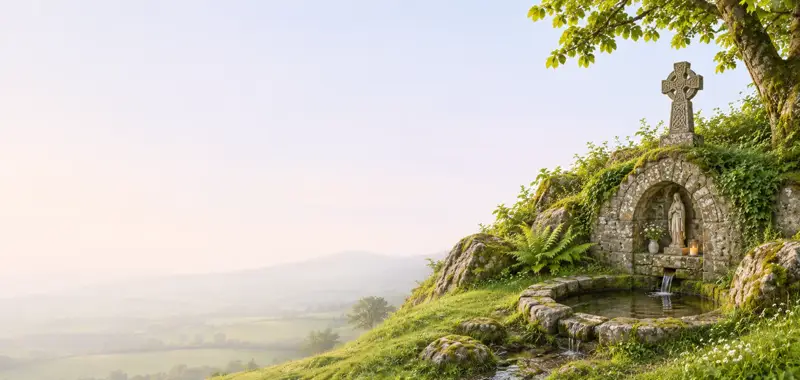
Unofficial guide. Not the National Monuments Service, the OPW, Fáilte Ireland or the landowner. Disclaimer
At a glance
- TypeRitual site - holy well
- Date or period mentioned4th century
What to look for
- Cross or cross-slab
- Pattern day
Picked out from the Archaeological Survey description below.
Can you visit?
- No source says it is open to the public.Most monuments in Ireland stand on private farmland.
- Ask the landowner before crossing fields, close gates, leave the stones as you find them.Visiting responsibly
History and description
Situated on the W side of a little N-S valley and at the base of an E-facing rock-outcrop (H c. 3m). According to John O’Donovan writing c. 1840 this holy well was frequented for the cure of sore eyes, but he does not provide the date of a pattern (O’Flanagan 1933, vol. 1, 270-1).
Full archaeological record 192 words
Situated on the W side of a little N-S valley and at the base of an E-facing rock-outcrop (H c. 3m). According to John O’Donovan writing c. 1840 this holy well was frequented for the cure of sore eyes, but he does not provide the date of a pattern (O’Flanagan 1933, vol. 1, 270-1). The well is a natural spring almost surrounded by furze and obscured by field stones. There is no evidence of veneration. The parish church of St. Helen’s (WX048-037001-) is c. 60m to the E.
The saint is probably Helena, the mother of Constantine who was the first Roman emperor to embrace Christianity in the early 4th century. She did not convert until late in life after Constantine, fighting under the sign of the ChiRho of Christ’s monogram, had defeated the Emperor Maxentius at the battle of Milvian Bridge on the river Tiber in AD 312. Helen devoted the rest of her days to church building in the Holy Land, and discovered the remains of the True Cross on Mount Calvary. She died in 326 or 328 AD. Her feast day is celebrated on August 18 (Butler 1883, 117).
Archaeological Survey of Ireland, National Monuments Service (CC BY 4.0) · Compiled by Michael Moore · Updated 7 January, 2014. It describes the site as it was when surveyed.
Folklore and traditions
According to John O’Donovan writing c. 1840 this holy well was frequented for the cure of sore eyes, but he does not provide the date of a pattern (O’Flanagan 1933, vol. 1, 270-1).
More holy wells nearby
St. Margaret's Well
Ritual site - holy well · St. Margarets · Wexford · 3.3 km away
Lady's Well
Ritual site - holy well · Eardownes Great · Wexford · 4.1 km away
St Mary's Well
Ritual site - holy well · Grahormack · Wexford · 4.7 km away
St Catherine's Well
Ritual site - holy well · Allenstown Big · Wexford · 5.0 km away
St Vauk's Well
Ritual site - holy well · St. Vogue'S · Wexford · 6.2 km away
St. Michael's Well
Ritual site - holy well · Bush (Forth By., Rosslare Ed) · Wexford · 6.7 km away
Visitors' notes
Badges are opinions of visitors - not verified facts. One vote per badge and visitor; no account needed.
Best time to visit
What's missing on this page?
Share a tip to find it
Share a local tradition or story
Suggest a correction
Suggest the right map location
Report a duplicate page
Ask a question
Do not include personal data. See our privacy notice.
Around St Helen's Well
Other heritage nearby
- St Ibar's Church, Our Lady's IslandAncient church · 4.5 km
- Sigginstown CastleCastle · 8.5 km
Recorded within 5 km
- 32 ringfortsArchaeological Survey of Ireland
- 9 ancient churchesArchaeological Survey of Ireland
- 5 castlesArchaeological Survey of Ireland
- 5 holy wellsArchaeological Survey of Ireland
- 3 standing stonesArchaeological Survey of Ireland
Walks and trails
- Ballytrent LoopWalking Trail · 6.4 km · nearest point 0.1 km
- St Helen's to Carne TrailWalking Trail · 4.1 km · nearest point 0.1 km
- Rosslare Harbour Clifftop WalkWalking Trail · 1.8 km · nearest point 1.8 km
Outdoors, towns and places to stay
- St Helens BayBeaches · 0.5 km
- Rosslare HarbourBeaches · 2.6 km
- The Raven Nature ReserveNature reserves · 14 km
- Wexford Wildfowl Reserve Nature ReserveNature reserves · 16 km
Other attractions nearby
- St. Helen's Bay BeachBeach · 0.8 km
- Rosslare Harbour BeachNatural Landscape · 2.5 km
- CarneBeach · 3.7 km
- Our Lady's Island MonasteryHistoric Houses and Castle · 4.2 km
What's on nearby
- Solve-Along-A-Murder-She-Wrote2026-11-07 · 15 km
- A Country Night in Nashville2026-11-07 · 15 km