


Unofficial guide. Not the National Monuments Service, the OPW, Fáilte Ireland or the landowner. Disclaimer
At a glance
- TypeHouse - fortified house
- Date or period mentioned17th century
- Condition (as surveyed)Gone: no visible trace
What to look for
- Wall-walk and parapet
- Bartizan
Picked out from the Archaeological Survey description below.
Can you visit?
- No source says it is open to the public.Most monuments in Ireland stand on private farmland.
- Ask the landowner before crossing fields, close gates, leave the stones as you find them.Visiting responsibly
History and description
Two ruinous medieval castles are depicted standing in the townland of Tullynally on the 1657 Down Survey map of the barony of Fore (NLI, MS 723-4). The terrier of the 1657 Down Survey map of Mayne parish lists Thomas FitzSyman (FitzSymons/FitzSimons) an Irish papist as the owner of the lands of Tullynally in 1641 (NLI, MS 723-4).
Full archaeological record 457 words
Two ruinous medieval castles are depicted standing in the townland of Tullynally on the 1657 Down Survey map of the barony of Fore (NLI, MS 723-4). The terrier of the 1657 Down Survey map of Mayne parish lists Thomas FitzSyman (FitzSymons/FitzSimons) an Irish papist as the owner of the lands of Tullynally in 1641 (NLI, MS 723-4). These forfeited lands were granted to Henry Pakenham in the second half of the 17th century, who built a new square shaped castle or fortified house possibly on or close to the site of the medieval castles depicted on the 1657 Down Survey map of the barony of Fore. The second medieval castle (WM003-093---) may have been located 150m W of Pakenham Hall. Henry Pakenham died in 1691 (Burke 1835 vol. 2, 160). The square-shaped plantation house of 17th century date forms the core of the present remains of Tullynally Castle. This plantation house is illustrated in a family diary dating from 1736. In this diary the land to the S of the house is landscaped with formal gardens below which there are canals and basins flanked by avenues of trees. Shortly after 1740 these formal gardens were replaced by ‘natural romantic’ landscaping by Thomas Pakenham. As part of this landscaping a Pleasure Ground was created to the W of the house along with a large walled kitchen garden and two ornamental lakes.
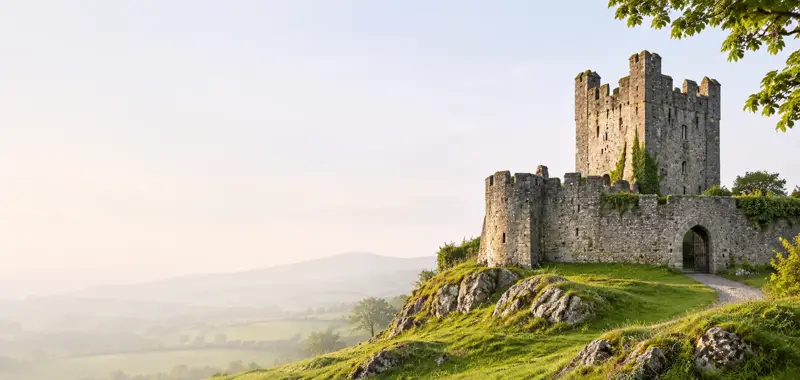
The National Inventory of Architectural Heritage described Tullynally Castle, the residence of the Pakenham family since the middle of the 17th century as following; ‘Five-bay three-storey country house with projecting end bays to each end of entrance façade (west), built c.1730. Originally a two-storey structure with third floor added c.1780. Extensive Gothic Revival and Tudoresque remodeling carried out on at least three separate occasions between c.1800 to c.1850 with three and four-storey towers and/or bartizans added to the corners, crenellations added to the parapets and the construction of a number of two storey wings (some over basement) containing kitchens, stables, laundry and staff and private accommodation arranged around two courtyards adjoining house to the north, generally in ashlar limestone, creating the present complex irregular plan. Possibly containing the fabric of a mid-to-late seventeenth century (fortified) house. Original house is roughcast rendered over coursed limestone masonry, exposed to east elevation. The original construction date of the initial phase of Tullynally Castle is difficult to ascertain and it is possible that the fabric of the original house built by Henry Pakenham, c.1655, is contained within the existing edifice’ (www.buildingsofireland.ie). According to family tradition the present house incorporated the remains of an earlier residence, which may have been the building built by Henry Pakenham around 1655. There is now no obvious trace of any features earlier than the 18th century.
Archaeological Survey of Ireland, National Monuments Service (CC BY 4.0) · Compiled by Frank Coyne & Caimin O'Brien · Updated 6 December 2016. It describes the site as it was when surveyed.
More castles nearby
 National Monument
Mortimer's Castle
Castle - unclassified · Faughalstown · Westmeath · 3.9 km away

Coolamber Hall House
House - fortified house · Coolamber · Longford · 10 km away
 Visitor site National Monument
Granard Motte and Bailey Castle
Castle - motte and bailey · Granard,Moatfield · Longford · 15 km away
 National Monument
Nugent Castle
Castle - tower house · Castletowndelvin · Westmeath · 17 km away

Martinstown Castle
Castle - tower house · Martinstown (Delvin By.) · Westmeath · 19 km away

Castlelost Castle
Castle - unclassified · Castlelost · Westmeath · 29 km away
Visitors' notes
Badges are opinions of visitors - not verified facts. One vote per badge and visitor; no account needed.
Best time to visit
What's missing on this page?
Share a tip to find it
Share a local tradition or story
Suggest a correction
Suggest the right map location
Report a duplicate page
Ask a question
Do not include personal data. See our privacy notice.
Around Tullynally Castle
Other heritage nearby
- Lady WellHoly well · 3.3 km
- BigwoodHillfort · 5.9 km
- St Brigid's WellHoly well · 5.9 km
- ForeAbbey or friary · 6.6 km
- Taghmon ChurchAncient church · 9.9 km
Recorded within 5 km
- 48 ringfortsArchaeological Survey of Ireland
- 9 castlesArchaeological Survey of Ireland
- 6 ancient churchesArchaeological Survey of Ireland
- 5 monastic sitesArchaeological Survey of Ireland
- 4 holy wellsArchaeological Survey of Ireland
- 2 megalithic tombsArchaeological Survey of Ireland
- 1 standing stoneArchaeological Survey of Ireland
Walks and trails
- Mullaghmeen White WalkWalking Trail · 8.1 km · nearest point 7.8 km
- Mullaghmeen Yellow WalkWalking Trail · 1.7 km · nearest point 7.9 km
- Mullaghmeen Multi Access TrailWalking Trail · 0.2 km · nearest point 8.2 km
Outdoors, towns and places to stay
- Mullaghmeen ForestForests · 8.2 km
- The Cut, Lough LeneBeaches · 9.0 km · Excellent Quality (2025)
- Portnashangan, Lough OwelBeaches · 12 km · Excellent Quality (2025)
- Scragh Bog Nature ReserveNature reserves · 12 km
- ForeWalled towns · 6.5 km
- Lough Bishop HouseHistoric stays · 6.5 km
Other attractions nearby
- Fore AbbeyHistoric Houses and Castle · 6.6 km
- MullaghmeenWalking · 9.1 km