
Unofficial guide. Not the National Monuments Service, the OPW, Fáilte Ireland or the landowner. Disclaimer
At a glance
- TypeChurch
What to look for
- East window
- Graveyard
- Sheela-na-gig
Picked out from the Archaeological Survey description below.
Can you visit?
- No source says it is open to the public.Most monuments in Ireland stand on private farmland.
- Ask the landowner before crossing fields, close gates, leave the stones as you find them.Visiting responsibly
History and description
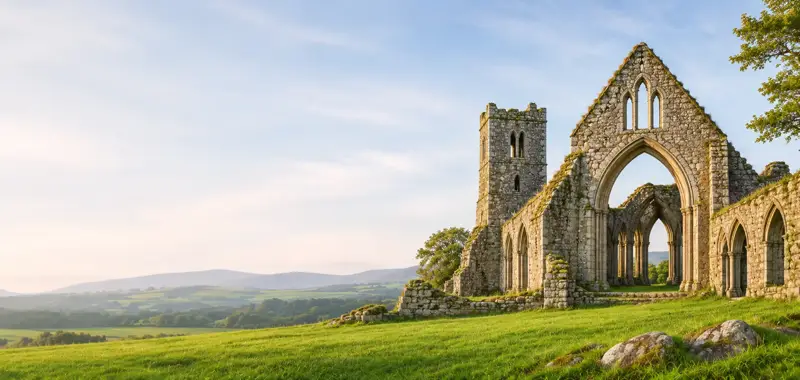
Kilsarkan (Cill tSearcon/Cill Shárcan, 'Sarcan's church) in the parish of Dysert, Diocese of Ardfert, barony of Trughanacmy was described in 1987 by the Castleisland District Archaeological Survey as follows; 'The Church is situated in the northern portion of the graveyard [KE049-086002-]. Only the eastern gable wall of the Church is now standing and the eastern portion of the south wall.
Full archaeological record 1,377 words
Kilsarkan (Cill tSearcon/Cill Shárcan, 'Sarcan's church) in the parish of Dysert, Diocese of Ardfert, barony of Trughanacmy was described in 1987 by the Castleisland District Archaeological Survey as follows; 'The Church is situated in the northern portion of the graveyard [KE049-086002-]. Only the eastern gable wall of the Church is now standing and the eastern portion of the south wall. There appears to be no surface indication of the north wall or west gable. The interior area of the Church and the areas of the north wall and of the west gable are covered in grave plots. All the gravestones appear to face east. Unfortunately the east gable is covered in dense ivy growth. It contains a window which appears to have splayed inwards. Old broken statues obviously from around the graveyard are now lying on the window sill. Externally there is a slight batter to the gable wall to a height of 90cm at the southeast corners. A number of well cut stone quoins are visible at the southeast corner. A combination of long flat stones and larger more boulder like stones are visible in the construction of the gable. The northeastern corner of the gable appears to be partly collapsed, it is concealed in dense ivy growth. The width of the gable measures 8m internally and 8.8m externally. The length of the remaining portion of the south wall measures 10.1m. What appears to be modern cement is visible on the internal face of the western end of the southern wall. It is not visible externally. An ogee headed window is set into the eastern end of the southern wall. A stone portraying an exhibitionist figure is set on top of the window. The figure has a roughly triangular shaped head with a rounded chin. It contains round staring eyes, a long flat nose and mouth, and ears which are set like cup handles on either side of the head. The body is triangular in outline, there is no visible neck or arms. The legs are visible, they are spread apart, that on the right (east) is at a higher level than the left (west). The figure appears to be sitting on top of the ogee head. A cross which appears to be the result of coins being rubbed in the middle of the ogee head partly conceals the body. Fifteen other crosses also the result of coin rubbing are visible down the length of this window. The window is situated at a height of c. 55cm from the present ground level. The overall length of the window c. 1.95m from the base of the sill stone to the top of the stone displaying the exhibitionist figure. The width of the window is 30cm while the width of the actual light measures c. 15cm. The length of the light measures 1.4m lying on the window sill (inside) is an old margarine tub containing coins. These are probably deposited as offerings having been used for rubbings.
The window in the east gable is situated externally at a height of 1.1m from the present ground level. (Measured to the base of its sill stone.) The length of the actual ope measures 1.65m. From the top of the sill stone.) The overall width of the ope is c. 3.5m measured at the base, however it was divided vertically into two ogee headed lights (each c. 1 6cm wide) by a central mullion, now missing. The window is surmounted by a hood-moulding. The window appears to have been constructed out of cut stone, however it is very difficult to examine as it is terribly over grown. Only the east gable and the eastern portion of the southern wall of this church are now standing. Unfortunately the east gable is largely obscured by ivy growth making it difficult to examine the window which it contains. An ogee headed window is situated in the eastern portion of the south wall. A stone set over it displays an exhibitionist figure with splayed legs, the right one at a higher level than the left. Round staring eyes, a flat nose, and mouth are set in a roughly triangular shaped head which has a rounded chin. The body is also triangular in shape, there is no indication of a neck or arms. The interior of the Church is covered by graves as are the areas of the north wall and west gable' (SMR File).
In 1942 the following details about this church was recorded; 'In Kilsarcon graveyard the gable end of an early Church still stands. Over the window a chiselled-out image can be clearly seen in a limestone square. Local folklore tales state that the image is that of St. Arcon, patron of the parish to whom rounds are paid every May. The public can enter at any time through a swing gate. An old custom still surviving is the practice of paying "Rounds" in Kilsarkan graveyard, In a cavity in the wall of the old Church a number of holy pictures have been placed. persons come during the month of May (Friday, Saturday and Sunday) and walk around the graveyard three times. Each time a Rosary is to be recited. On the completion of the third Rosary, the pilgrim goes to the remaining window to touch the engraved image of St. Arcon [patron of the parish]. The pilgrim then goes to the holy pictures to say any prayer in conclusion. Before departing something is left at the foot of the old wall preferably a holy book (Messenger, etc.). many of these are to be seen today. The "Rounds" are said for cures or for departed relatives or friends' (ITA Survey).
Kilsarkan East church and graveyard (KE049-086002-) was surveyed in 2007 by Laurence Dunne and described as follows; 'Situated on an elevated site which slopes from south to north, there are expansive views to the north, west and east. The northern end of the graveyard wall contains flag-like stones with some large sandstone blocks which may originally have formed the church. The church is in a poor state of preservation with only the eastern and most of the southern elevations remain upstanding. It was impossible to comprehensively examine the eastern elevation as it is completely overgrown with ivy. The southern elevation is only partially upstanding at its eastern end. The exposed interior area of the church contains many graves and a large pile of rubble masonry is pile in the southeast corner of the church.
The eastern elevation has a centrally disposed window ope which is obscured by the vegetation. Large unhewn sandstone blocks are visible through the overgrowth. The full length of the wall does not survive. The window ope is completely trapped by ivy. It is composed of a single pointed limestone head with a single rebate evident and sockets for window iron also visible. The window sill is currently being used as a makeshift altar with deposits of holy statues and rosary beads present. The remnants of the southern elevation is a denuded, tapering wall which rises from 1m, on what survives of the western end, to full height at the eastern end. The quoin stones evident on the southeast corner of the elevation are contemporary with the surviving window. A heavy growth of ivy covers the walls. A single ogee headed cut limestone window ope is present in the southeast corner of the wall. This window is interesting and unusual as a sheela-na-gig (KE048-086005-), forms the apex of the window. However, in recent years, a custom seems to have evolved where the window has become a stopping point while saying the rosary and a cross is then scratched with a stone by the devotee at several locations on the window’s side stones and indeed on the sheela-na-gig but in particular on the sill stone which is also unfortunately cracked through. A rough stone is placed on the window sill for this purpose. On the interior the splayed embrasure of the sheela-na-gig window has been mostly robbed out as well as other side fabric material. The inner head of the window and surrounding masonry are all missing. A broken piscina is located to the immediate east of the window, in the southeast corner of the church' (Buckley and Dunne 2007, 6-7).
Archaeological Survey of Ireland, National Monuments Service (CC BY 4.0) · Compiled by Caimin O'Brien based on details provided by Laurence Dunne. It describes the site as it was when surveyed.
Folklore and traditions
These are probably deposited as offerings having been used for rubbings.
Local folklore tales state that the image is that of St. Arcon, patron of the parish to whom rounds are paid every May.
An old custom still surviving is the practice of paying "Rounds" in Kilsarkan graveyard, In a cavity in the wall of the old Church a number of holy pictures have been placed. persons come during the month of May (Friday, Saturday and Sunday) and walk around the graveyard three times.
The pilgrim then goes to the holy pictures to say any prayer in conclusion.
The "Rounds" are said for cures or for departed relatives or friends' (ITA Survey).
The window sill is currently being used as a makeshift altar with deposits of holy statues and rosary beads present.
More ancient churches nearby
Killeentierna Church
Church · Killeentierna · Kerry · 5.0 km away
Kilnananima Church
Church · Cordal East · Kerry · 7.2 km away
Kilcummin Church
Church · Glebe (Magunihy By., Kilcummin Ed) · Kerry · 7.3 km away
Kilmurry Church
Church · Kilquane (Trughanacmy By., Cordal Ed) · Kerry · 7.9 km away
Ardcrone Church
Church · Ardcrone · Kerry · 9.0 km away
Kilbannivane Church
Church · Kilbannivane · Kerry · 9.1 km away
Visitors' notes
Badges are opinions of visitors - not verified facts. One vote per badge and visitor; no account needed.
Best time to visit
What's missing on this page?
Share a tip to find it
Share a local tradition or story
Suggest a correction
Suggest the right map location
Report a duplicate page
Ask a question
Do not include personal data. See our privacy notice.
Around Kilsarkan Church
Other heritage nearby
- Crag CaveCave · 9.9 km
Recorded within 5 km
- 47 ringfortsArchaeological Survey of Ireland
- 2 ogham stonesArchaeological Survey of Ireland
- 2 ancient churchesArchaeological Survey of Ireland
- 2 stone circlesArchaeological Survey of Ireland
- 2 standing stonesArchaeological Survey of Ireland
Walks and trails
- Duhallow - Doctors Hill LoopWalking Trail · 5.2 km · nearest point 11 km
- Duhallow - Source of Blackwater LoopWalking Trail · 10.7 km · nearest point 11 km
- Glanageenty LoopWalking Trail · 3.8 km · nearest point 14 km
Outdoors, towns and places to stay
- Pike WoodForests · 12 km
- GlanageentyForests · 15 km
- Sheheree Bog Nature ReserveNature reserves · 14 km
Other attractions nearby
- Anglers Paradise Fishing Guides KillarneyNature and Wildlife · 8.8 km
- Quiet AdventuresWalking · 9.8 km
- Falconry KerryNature and Wildlife · 10.0 km
- Killarney Bee Walks and HoneyNature and Wildlife · 10.0 km
What's on nearby
- Sorcha Richardson2026-11-05 · 14 km
- Gearoid McCarthy2026-11-06 · 14 km
- Dominic Kirwan In Concert2026-11-07 · 14 km