


Unofficial guide. Not the National Monuments Service, the OPW, Fáilte Ireland or the landowner. Disclaimer
At a glance
- TypeRound tower
- StatusNational Monument
What to look for
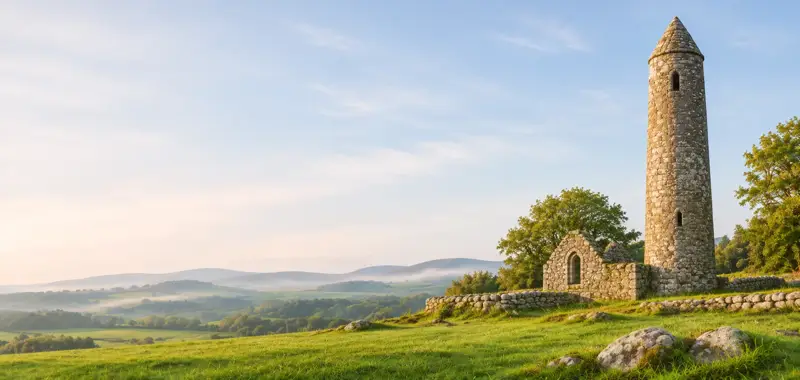
- Conical cap
- Windows
Picked out from the Archaeological Survey description below.
Can you visit?
- No source says it is open to the public.Most monuments in Ireland stand on private farmland.
- Ask the landowner before crossing fields, close gates, leave the stones as you find them.Visiting responsibly
History and description
National Monument No. 55. Rattoo Round tower described in the Urban Survey of Kerry as follows: ‘One of the finest in the country, this round tower is complete, the, top two-thirds of the conical cap having been replaced in 1880-1 by the Commissioners of Public Works (Barrow 1979, 109).
Full archaeological record 779 words
National Monument No. 55. Rattoo Round tower described in the Urban Survey of Kerry as follows: ‘One of the finest in the country, this round tower is complete, the, top two-thirds of the conical cap having been replaced in 1880-1 by the Commissioners of Public Works (Barrow 1979, 109). It is built of dressed and evenly coursed yellow sandstone and stands to a height of approx. 27m. It is evenly battered from an off-set 20cm wide at the base to a cornice just below the cap. A limestone Plinth is present under the off-set. There were six floors set on projecting rings of corbels but there is no access to the floors now.
There is a round headed door in the SE 2. 6m above the off-set, a small pointed window in the fourth floor above the door and four windows in the top of the tower. The door has a low flat moulding carried around the arch and jambs and the sill projects from the face of the tower giving the effect of a continuation of the moulding. There is a rounded moulding with two curved spirals on the top of the arch and two others two around the sides of the flat moulding and terminate in a spiral on either side of the door. When the tower was being repaired in the late nineteenth century a shiela-na-gig and some pellet mouldings were discovered on the inner frame of the north window (Barrow 1979, 112)’ (Bradley et. al. 1987, 85).
Described by the North Kerry Archaeological Survey as; 'This complete tower, which stands on a platform of masonry, rises to a maximum height of 29.56m (OPW) and is constructed of hard quartzose sandstone, which is well dressed and coursed internally and externally. The tower is 15m in circumference at the base. The internal diameter is 2.3m at the doorway, where the walls are a little over 1m thick. The external wall would appear to batter from the base to the cornice, and the external diameter at the sills of the top windows measures 3.5m (OPW). This means that over a height of 21.44m, there is a reduction in radius of 55cm, giving a batter of 1.39.
Originally there were five storeys above the basement, measuring 6.1m, 4.2m, 3.4m and 4.2m high, with the top storey 3.1m high to the cornice plus 2.8m to the internal vertex. Between the floors of each storey, rough corbel stones project. The top floor windows face a little to the right of the cardinal points and measured 1.45m to the apex, 51cm wide at the base and 43cm wide at the springing. The only other window is on the fourth floor. It measures 76cm to the apex, 43cm wide at the base and 33m wide at the springing.
The round-headed doorway is situated 2.83m above ground level and is 1.6m high. It consists of a semi-circular arch of three stones ornamented with a simple curvilinear motif in relief. The carving is about 1cm in thickness and is much weathered. The central portion above the central stone has upturned curving spirals at each end measuring 4.5cm in diameter; the central portion of the relief motif measures 20cm overall. Extending from the underneath of each spiral is a plain bead moulding which rounds the arch for 44cm and then terminates on either side in curving spirals. The two spirals on either side of the arch extend in the same direction, clockwise on the left and anti-clockwise on the right. This design appears to be unique for a round tower.
Another feature unique to this round tower is the Sheela-na-gig (KE009-056002-), which is situated on the top left- hand corner of the frame of the N window, facing in to the interior of the tower. This feature was discovered in 1880-81, when the top two-thirds of the cap were being reset. A plaster cast of the Sheela-na-gig now lies in the National Museum. It is carved in relief on two stones, the head and shoulders set on the end of the lintel stone and the rest on the jamb stone below it. It measures 30cm from head to foot and 14cm at the widest point across the knees.
In 1832, when William Morrison visited the tower, it stood on a circular earthen terrace with a causeway running below its doorway E for about 38.7m. This, however, is now only discernible from the air. The land around the tower belonged to the Gunn family who lived in Rattoo House, which is situated on the N side of the field. Around 1880, when Mr Wilson Gunn drained and planted the land, the causeway disappeared' (Toal 1995, no. 970).
References
- Date of revised upload: 4 May 2022
Archaeological Survey of Ireland, National Monuments Service (CC BY 4.0) · Compiled by Caimin O'Brien. It describes the site as it was when surveyed.
More round towers nearby
Ardfert Round Tower
Round tower · Ardfert · Kerry · 16 km away

Scattery Island Round Tower
Round tower · Scattery Island · Clare · 21 km away
Visitors' notes
Badges are opinions of visitors - not verified facts. One vote per badge and visitor; no account needed.
Best time to visit
What's missing on this page?
Share a tip to find it
Share a local tradition or story
Suggest a correction
Suggest the right map location
Report a duplicate page
Ask a question
Do not include personal data. See our privacy notice.
Around Rattoo Round Tower
Other heritage nearby
- Rattoo ChurchAncient church · 0.0 km
- Rattoo Early Medieval Ecclesiastical SiteMonastic site · 0.1 km
- Derryco ChurchAncient church · 3.6 km
- TobereleeshHoly well · 4.1 km
- Kiltomy ChurchAncient church · 4.5 km
- Kilmore ChurchAncient church · 4.9 km
Recorded within 5 km
- 71 ringfortsArchaeological Survey of Ireland
- 7 ancient churchesArchaeological Survey of Ireland
- 5 monastic sitesArchaeological Survey of Ireland
- 3 holy wellsArchaeological Survey of Ireland
- 1 abbey or friaryArchaeological Survey of Ireland
- 1 castleArchaeological Survey of Ireland
Walks and trails
- Ballybunion Loops - Beach WalkWalking Trail · 7.2 km · nearest point 5.3 km
- Ballybunion Loops - Lahardane Hill WalkWalking Trail · 8.3 km · nearest point 7.1 km
- Shannon WayWalking Trail · 39.4 km · nearest point 7.8 km
Outdoors, towns and places to stay
- Ballybunnion SouthBeaches · 7.9 km · Excellent Quality (2025)
- Ballybunnion NorthBeaches · 8.1 km · Excellent Quality (2025)
- Loop Head Lightkeeper's HouseHistoric stays · 23 km
Other attractions nearby
- Fitzmaurice CastleHistoric Houses and Castle · 7.9 km
- Ballybunion BeachHistoric Houses and Castle · 8.0 km
- Ballybunion NorthBeach · 8.0 km
- Ballybunion SouthBeach · 8.0 km
What's on nearby
- Listowel Food Fair 20262026-11-05 · 11 km
- National Circus Festival of Ireland2026-11-05 · 20 km
- Samhaini Chiarrai - Fire Rituals2026-11-06 · 20 km · free