


Unofficial guide. Not the National Monuments Service, the OPW, Fáilte Ireland or the landowner. Disclaimer
At a glance
- TypeCastle - tower house
- Date or period mentioned12th century
- StatusNational Monument
What to look for
- Wall-walk and parapet
- Spiral stair
- Murder hole
- Machicolation
- Bawn wall
- Vaulted floor
Picked out from the Archaeological Survey description below.
Can you visit?
- No source says it is open to the public.Most monuments in Ireland stand on private farmland.
- Ask the landowner before crossing fields, close gates, leave the stones as you find them.Visiting responsibly
History and description
There are references to the Rossiters in Ireland from the late 12th century when the first Rossiter from Lincolnshire landed with Maurice de Prendergast at Bannow in 1169, and to Rossiters of Rathmacknee from the early 14th century (Martin 1949, 104).
Full archaeological record 1,031 words
There are references to the Rossiters in Ireland from the late 12th century when the first Rossiter from Lincolnshire landed with Maurice de Prendergast at Bannow in 1169, and to Rossiters of Rathmacknee from the early 14th century (Martin 1949, 104). Rathmacknee is thought to be the principal and primary caput or centre of the Rossiters, from which they went on to build castles at Slevoy (WX041-015----), Tomhaggard (WX047-050----), Bridge Bargy (WX047-047----), and Newcastle (WX042-024001-) and perhaps others. John Rossiter of Rathmacknee was seneschal, or governor, of the county in 1451, and his grandson, Thomas was seneschal in 1493. Either of the seneschals is thought to have built the castle in the later 15th century (Leask 1953, 38). When Thomas Rossiter died in 1592 he left a four year old heir, John, with land in eight townlands, and nine daughters who married into the principal families of south Wexford (Martin 1949, 110-1). Thomas’ widow, Anastasia (nee Synnott of Ballybrennan (WX048-001001-), married again to Rowland Scurlocke, whose paternal grandfather, Rowland, had been the physician of Queen Mary Tudor (1553-8) and had been rewarded with the manors of Rosslare and Ballymore for his services (Hore 1920, 93).
John’s son, Thomas (1612-c. 1690), played a leading part in the 1641 rebellion, and was a friend of the Papal Nuncio, Cardinal Rinucini, who stayed at Rathmacknee when in Wexford (Martin 1950, 13). Thomas’s wife, Ann Sarsfield, was an aunt of Patrick Sarsfield of the battle of Aughrim fame (1691), and her brother, Sir Patrick, was a son-in-law of Rory O’Moore, the principal instigator of the 1641 rebellion (ibid. 14-5). According to the Book of Survey and Distribution Thomas Rossiter owned almost 700 acres in Rathmacknee parish in 1640 (Simington 1953, 300), but was only assigned 66 acres in Connaught under the plantation (Hore 1900-11, vol. 6, 506). Although Walter, a grandson of Thomas, briefly re-occupied Rathmacknee in 1689-90, the Rossiters never regained their Rathmacknee possessions (Martin 1950, 16-7), which passed to Captain Thomas Knox, who died in 1687 (Jeffrey 1979, 33).
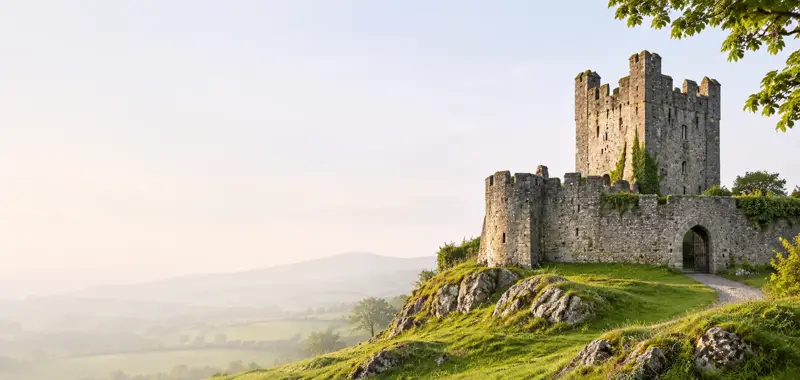
The remains consist of a tower house and rectangular bawn which survive complete and have been conserved as a national monument (Harbison 1975, 248). The bawn was once inside a D-shaped earthwork enclosure (WX042-029004-), for which there is only cartographic evidence. The tower house is a rectangular structure (ext. dims 9.7m N-S; 8.9m E-W) of five floors surviving complete with a garderobe tower projecting S at the SE angle, good quoins and a base batter. A pointed doorway of undressed stone towards the S end of the W wall is protected by an opening on the battlements, probably for a wooden machicolation. From the lobby with a murder-hole a reconstructed doorway leads to the ground floor (int. dims 5.62m E-W; 3.95m N-S), which has a double-splay loop on the N wall covering the gateway to the bawn.
From the lobby a mural stairs in the W wall gives access through a lintelled doorway to the first floor with one window under the E-W vault. The floor of the first storey is supported on corbels in the N and S walls and there is an antechamber at the NW angle. The stairs continue in the W wall and turn into the N wall where a lintelled doorway leads to the second floor over the vault. There is a large antechamber in the N wall, entered by a lintelled doorway at the E end, and there is an entrance to an oubliette or hidden chamber below built into the barrel-vault. The garderobe at the SE angle is entered through a lintelled doorway, and there is a double ogee-headed window in the E wall. The fireplace with an oversailing canopy supported on corbels is in the centre of the S wall, and the chimney flue is supported on corbels on the outer face of the wall. The S wall has a single ogee-headed window with seats W of the fireplace. An embrasure at the S end of the W wall led to the wall-walk of the S bawn wall, but this is reduced to a single rectangular window now, while the ceiling was supported on corbels in the N and S walls.
The mural stairs continue in the N wall to the upper floors that are now inaccessible. The third floor has a fireplace in the S wall, a double ogee headed window in the E wall, and single ogee-headed windows in the S (blocked) and W walls, There is a garderobe at the SE angle, and an antechamber in the N wall, while the ceiling is supported on corbels in the N and S walls. The mural stairs continue in the N wall to the fourth floor which has small lintelled windows with seats in the E, S and W walls, a single light in the N wall and antechambers at the NE and SE angles. There are corbels in the N and S walls for the ceiling, which suggest that there may have been an attic in the roof that was probably hipped as there are no gables on the wall-walk above. The stairs continue in the N wall and emerge on the wall-walk at the E side. There are stepped crenellations and look-out platforms above all the angles except the NW, which overlooks the bawn. The SE and SW look-outs are supported on columns, allowing passage beneath them, and steps attached to the inner face of the wall-walk parapets allow access to the look-outs.
The tower house is at the SE angle of the bawn (int. dims 25.5m E-W; 20m N-S), whose walls survive complete with a wall walk (H 7.3m), except on the S where a house with walls 1.5m thick at one time abutted the tower house (Wexford People 15-07-1911). A pointed gateway (Wth 1.9m; H 2.55m) protected by machicolation is on the E wall, immediately N of the tower house. There is machicolation on the NE angle and the remains of machicolation at the NW angle. An 18th or 19th-century house inside the W wall of the bawn is still occupied. Rathmacknee church site (WX042-029001-) is c. 30m to the S.
This is a National Monument in state guardianship: No. 434.
References
- Amended: 3 January, 2014
Archaeological Survey of Ireland, National Monuments Service (CC BY 4.0) · Compiled by Michael Moore · Updated 28 May, 2013 · Based on the Archaeological Inventory of County Wexford. It describes the site as it was when surveyed.
More castles nearby

Rathlannon castle
Castle - tower house · Johnstown (Forth By.) · Wexford · 2.7 km away
 Visitor site
Sigginstown Castle
Castle - tower house · Sigginstown · Wexford · 7.8 km away

Barntown Castle
Castle - tower house · Barntown · Wexford · 8.1 km away

Ballyhealy Castle
Castle - tower house · Ballyhealy Castle · Wexford · 8.8 km away

Ferrycarrig Castle
Castle - tower house · Ferrycarrig · Wexford · 9.2 km away

Artramon Castle
Castle - tower house · Artramon · Wexford · 12 km away
Visitors' notes
Badges are opinions of visitors - not verified facts. One vote per badge and visitor; no account needed.
Best time to visit
What's missing on this page?
Share a tip to find it
Share a local tradition or story
Suggest a correction
Suggest the right map location
Report a duplicate page
Ask a question
Do not include personal data. See our privacy notice.
Around Rathmacknee Castle
Other heritage nearby
- St Catherine's WellHoly well · 2.3 km
- St Catherine's WellHoly well · 2.4 km
- St Fintan's WellHoly well · 3.0 km
- St. Helen's WellHoly well · 3.9 km
- St. Keevil's WellHoly well · 3.9 km
- St Catherine's WellHoly well · 4.9 km
Recorded within 5 km
- 26 ringfortsArchaeological Survey of Ireland
- 14 ancient churchesArchaeological Survey of Ireland
- 10 castlesArchaeological Survey of Ireland
- 9 holy wellsArchaeological Survey of Ireland
- 1 standing stoneArchaeological Survey of Ireland
Walks and trails
- Wexford Cycle Hub Loop 3Road Cycling Trail · 77.3 km · nearest point 6.1 km
- Forth Mountain TrailWalking Trail · 7.1 km · nearest point 6.7 km
- Three Rocks TrailWalking Trail · 13.3 km · nearest point 6.7 km
Outdoors, towns and places to stay
- Shelmaliere / Forth MountainForests · 6.7 km
- Rosslare StrandBeaches · 7.2 km · Excellent Quality (2025)
- BallyhealyBeaches · 9.5 km
- Wexford Wildfowl Reserve Nature ReserveNature reserves · 11 km
- The Raven Nature ReserveNature reserves · 13 km
- WexfordWalled towns · 8.0 km
Other attractions nearby
- Rosslare StrandBeach · 7.2 km
- The Norman Way - Heritage and Cycling trailHistoric Houses and Castle · 7.7 km
- Shelmalier Forth MountainNature and Wildlife · 7.7 km
- RacontourNature and Wildlife · 7.7 km
What's on nearby
- Solve-Along-A-Murder-She-Wrote2026-11-07 · 7.9 km
- A Country Night in Nashville2026-11-07 · 7.9 km
- Niall Breslin & The Polaris Quartet The Place that has Never Been Wounded2026-11-08 · 7.9 km