


Unofficial guide. Not the National Monuments Service, the OPW, Fáilte Ireland or the landowner. Disclaimer
At a glance
- TypeChurch
- Date or period mentioned13th century
What to look for
- Nave and chancel
- East window
- Graveyard
- Bellcote
Picked out from the Archaeological Survey description below.
Can you visit?
- No source says it is open to the public.Most monuments in Ireland stand on private farmland.
- Ask the landowner before crossing fields, close gates, leave the stones as you find them.Visiting responsibly
History and description
On a slight ridge in the valley floor with good views in all directions. The field surrounding the church has numerous earthworks (KK009-013005-) indicative of settlement, possibly associated with the church.
Full archaeological record 503 words
On a slight ridge in the valley floor with good views in all directions. The field surrounding the church has numerous earthworks (KK009-013005-) indicative of settlement, possibly associated with the church. Carrigan (1905, vol. 2, 310-12) describes the various references to the church and parish of Aharney, with its various different spellings since the 13th century. He relates how, ‘the parish of Aghteyr was appropriated to the Priory of Inishtioge’ and remained their property until the Reformation (ibid. 311). In 1541 the rectory of ‘Agheteart’ was leased to Richard Butler of Ferns, in 1576-7 to James and Edward Cuffe and in 1584 to Henry Davelles (ibid. 311). Post-Reformation the church once again became a parish church (ibid. 311). Carrigan (ibid.) notes that, ‘In the Regal Visitation of 1615 it was found that the Rectory of Acghtier was worth £5, and that the parish church and chancel were in course of repair’. Also, Carrigan (ibid. 314) refers to a local belief that, 'Barony Church was re-roofed and was used again as the Catholic chapel of the district, during the Williamite and Jacobite war; and they say that the oak couples of the roof remained in position till late in the 18th century'.
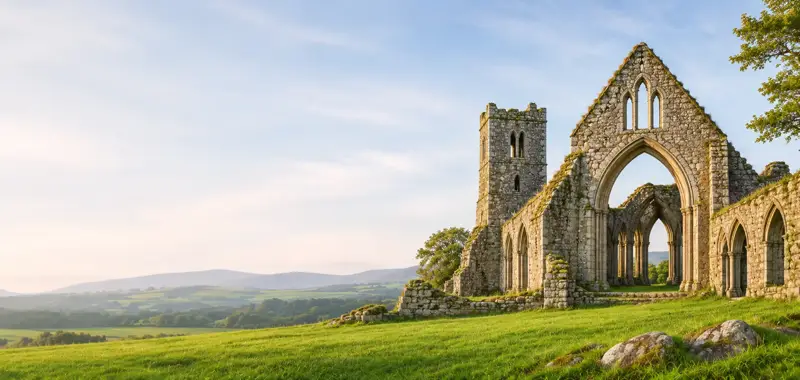
A nave (int. dims. 7.2m N-S; 17m E-W) and chancel (dims. 5.2m N-S; 8m E-W) church of roughly coursed limestone rubble, aligned E-W, with the side walls (T 0.9m) and gables surviving in good condition. There is a single bell bellcote at the apex of the W gable. There are two buttresses against the external E gable. The church was entered at the W end through either of the roughly opposing doorways in the N and S wall, both broken out. There is a flat-headed single-light window at the E end of the N within a round-headed embrasure and one, broken out, opposite in the S wall. There are corbels at the W end of the church which would have supported a gallery. The round-headed chancel arch (H 2.4m; Wth 2.6m) has been subsequently blocked up and a doorway inserted giving access to the chancel which was ‘roofed and fitted up, several years ago, to serve as a mortuary chapel for the Mountgarret family’ (ibid. 312). Carrigan (ibid.) notes that, ‘All its distinctive features were then destroyed except a very handsome piscina of gothic design, with ornamental bowl’. The piscina is within a chamfered pointed niche and has a fluted bowl. The chapel is lit by two single-light flat-headed windows within round-headed embrasures, each being at the E end of the N and S wall respectively, and by an elliptical-headed two-light window in the E gable. The voussoirs of the E window, visible externally, suggest that there may have been an earlier pointed window. Within the chapel there is a wall monument (KK009-013006-), dated 1634, in the NE angle and a graveslab (KK009-013007-), dated 1694, in the NW angle. The modern graveyard enclosing the church is a reduced version of an earlier graveyard (KK009-013002-) which is enclosed by a low earthen bank.
Archaeological Survey of Ireland, National Monuments Service (CC BY 4.0) · Compiled by Jean Farrelly · Updated 16 July 2018. It describes the site as it was when surveyed.
More ancient churches nearby
Ballyconra Church
Church · Ballyconra · Kilkenny · 2.5 km away
Grange Church
Church · Grange (Fassadinin By.) · Kilkenny · 2.6 km away

Donaghmore Church
Church · Donaghmore (Fassadinin By.) · Kilkenny · 2.7 km away

Saint Finan's Church
Church · Gorteenara · Kilkenny · 3.7 km away
Clontubbrid Church
Church · Clontubbrid · Kilkenny · 4.5 km away
Durrow Church (site of)
Church · Durrow Townparks · Laois · 6.5 km away
Visitors' notes
Badges are opinions of visitors - not verified facts. One vote per badge and visitor; no account needed.
Best time to visit
What's missing on this page?
Share a tip to find it
Share a local tradition or story
Suggest a correction
Suggest the right map location
Report a duplicate page
Ask a question
Do not include personal data. See our privacy notice.
Around Barney Church
Other heritage nearby
- Saint Brigid's Well (site of)Holy well · 0.1 km
- Seskin CastleCastle · 1.8 km
- Ballyragget CastleCastle · 2.0 km
- Moatpark CastleCastle · 2.1 km
- Lisdowney CastleCastle · 2.1 km
- St Bridget's WellHoly well · 3.0 km
Recorded within 5 km
- 20 ringfortsArchaeological Survey of Ireland
- 13 ancient churchesArchaeological Survey of Ireland
- 12 castlesArchaeological Survey of Ireland
- 6 holy wellsArchaeological Survey of Ireland
- 2 megalithic tombsArchaeological Survey of Ireland
- 1 monastic siteArchaeological Survey of Ireland
- 1 hillfortArchaeological Survey of Ireland
Walks and trails
- North Kilkenny Cycle RouteRoad Cycling Trail · 80.5 km · nearest point 1.1 km
- Durrow Leafy Long LoopWalking Trail · 20.1 km · nearest point 4.6 km
- Cullahill - Binnianea LoopWalking Trail · 9.8 km · nearest point 5.0 km
Outdoors, towns and places to stay
- CapponellanForests · 6.6 km
- Dunmore WoodForests · 7.6 km
- Coolacurragh Wood Nature ReserveNature reserves · 13 km
- Grantstown Wood and Grantstown Lough Nature ReserveNature reserves · 13 km
- Clomanatagh CastleHistoric stays · 11 km
Other attractions nearby
- The Irish Fly Fishing and Game MuseumMuseums and Attraction · 4.9 km
- Gardens at Castle DurrowHistoric Houses and Castle · 6.6 km
- River NoreNature and Wildlife · 7.0 km
What's on nearby
- Pa Sheehy The Magic We Found Tour2026-11-05 · 17 km
- Kilkenomics2026-11-06 · 17 km
- Kilkenomics2026-11-07 · 17 km