
Unofficial guide. Not the National Monuments Service, the OPW, Fáilte Ireland or the landowner. Disclaimer
At a glance
- TypeChurch
- Condition (as surveyed)Ruined
What to look for
- Nave and chancel
- East window
- Graveyard
- Bellcote
Picked out from the Archaeological Survey description below.
Can you visit?
- No source says it is open to the public.Most monuments in Ireland stand on private farmland.
- Ask the landowner before crossing fields, close gates, leave the stones as you find them.Visiting responsibly
History and description
Ballyboghil (town of the staff or the Bachall of Patrick) church ruins in S quadrant of graveyard (DU007-010002-), just N of Ballyboghil village. In 1615, the Royal Visitation of Dublin recorded that in the Deanery of Lusk, there was the Church of Ballyboghil served by the curate Nicholas Bacon (Ronan 1941, 26).
Full archaeological record 961 words
Ballyboghil (town of the staff or the Bachall of Patrick) church ruins in S quadrant of graveyard (DU007-010002-), just N of Ballyboghil village. In 1615, the Royal Visitation of Dublin recorded that in the Deanery of Lusk, there was the Church of Ballyboghil served by the curate Nicholas Bacon (Ronan 1941, 26). Ronan (ibid.) recorded that following details about Ballyboghil church; 'In a grant of Ballibaghill to St. Mary's Abbey by Gilbert, Archbishop of Armagh, c. 1175-1180, the land is called the 'Land of St. Patrick', and it is stated that his predecessor Ceallach (1106-1129) had a "freer and fuller right" to it (Gilbert, Chart. St. Mary's, Dublin, I, 141). Ceallach had obtained the metropolitanship of Norse-Irish Dublin, apparently by agreement with Samuel O h-Aingli, Bishop of Dublin, about 1113 (ibid., II, 254 ;AFM, at 1121). Apparently at this time he obtained the town of Ballibaghill and the lands around it for the preservation of the Bachall losa and in recognition of his own metropolitanship instead of that of Canterbury to which Dublin had been subject. In 1173, Strongbow, after a siege of four days, took Ballibaghill from Mac Goghdane, and, having beheaded him, granted "illo die" the 'Land of St. Patrick' and the Bachall to Holy Trinity, Dublin (Liber Albus, Christ Church, fol. 46b.). Evidently the contest between these two powerful warriors was for these possessions. After the death of Gelasius, Archbishop of Armagh, in 1174, there was a dispute about the succession. The Anglo-Normans favoured Gilbert who became archbishop in 1175, Conchubhar, his opponent, having gone to Rome. (Lawlor, in Proc. RIA, XXXV. c. no. 9. p. 356). Strongbow died in 1176, and, probably immediately afterwards, Gilbert, who had now undisputed right to Ballibaghill and the Bachall, granted the lands to St. Mary's Abbey and the Bachall to Holy Trinity. Before his recall to England in 1177, Fitz Adelm, the Governor of Dublin, had the Bachall transferred to Holy Trinity (Gir. Cam., Hib. Expug., II, 28). Apparently this was done for the safety of the precious relic by removing it from the grasp of contending coarbs of Patrick. Malachy had already had trouble in this matter from Niall who claimed the coarbship in 1134 (St. Bernard's Life of St. Malachy, c.4 ; AFM, at 1135). Ware says that Ballibaghill was called from the Bachall of Patrick (Archbishops of Armagh, at 1180). The ruins of the church are very fine and show a fine triple-arched bell-turret. The Bachall, "the great relicke of Erlonde", having been preserved in Holy Trinity for over 350 years, was ordered to be burnt by Henry VIII's archbishop of Dublin, George Browne, in 1538, in front of the cathedral, as an object of superstition (Ronan, Reformation in Dublin, pp. 117-8). In 1630, Archbishop Bulkeley’s Visitation of Dublin, recorded the following details about Ballyboghil; 'The church and chauncell are much out of repairacon. The tithes are impropriate, esteemed to be worth five score pecks of corne per annum, belonging to the Sword. Gabriell Etheridge, clarke, is curate, who hath the small tythes, being worthe v libri per annum, for serving the cure. All the parishioners are recusants. The curate certified that there was wont to be paid by the Lord Deputy, or Lords Justices of the Kingdome, to the curate, by way of concordatum, the sume of iii libri sterling, of which he is behinde this fower yeares' (Ronan 1941, 71).
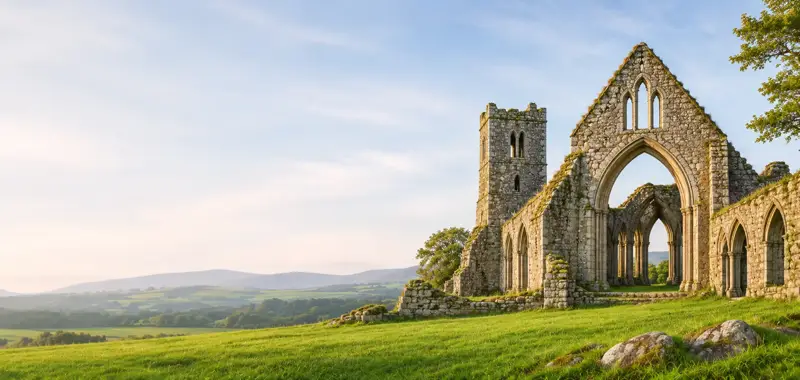
Ballyboghil Church ruins described in 1887 as; 'This interesting old church, on an elevation surrounded by stately elm trees, and just above the village of the same name, is one of the most perfect and striking of the ruined churches of Fingal. It is 71 feet [21.6m] long by 25 [7.6m] wide, and, like all the other Fingal ruins, runs due E and W. The walls are nearly complete. The masonry is in fair condition. The corners are of chiselled stone. The W. gable rises in a perfect triple-arched bell-turret, the wall of which is 4½ feet [1.2m] thick. A perfect set of stone steps, from the top of the S wall, ascends to the E side of these belfry arches. The doors are arched. There are the remains of a fine E window in the chancel, 15 feet [4.5m] high by 7 [2.1m] wide, with arches of carved sandstone. At the SE chancel end there is a lancet-arched niche of 6 feet [1.8m] span, which apparently once covered a recumbent tombstone; farther to the W is a small lancet-arched doorway, 4½ feet [1.2m] by 2½ feet [0.7m] wide leading out to a vault, the masonry of which seems of the same date as that of the church. It is uncared for, without a name, the entrance is open, and it is full of human bones. The church dates, and was used, from the English invasion. Both church and chancel are said to have been out of repair A.D. 1630, but the church was in use then' (Walsh 1888, 246).
The church is oblong in plan with an undivided nave and chancel (dims. 18.9m E-W x 5.6m N-S). Built of coursed masonry with dressed quoins, displaying extensive evidence for re-building. There is a triple bell-cote on the W gable with stone steps. Originally entered through opposing flattened arched doorways at W end of nave and through a narrow pointed arched doorway in the S wall of chancel. Interior is lit by plain single light opes with stepped embrasures in nave and chancel. The W window is of segmental-arched type, the E is a large pointed arched window, which rises to to the full height of the E gable. It has sandstone mouldings and a carved female head on the label stop. Arched tomb recesses in W and S walls. Aumbry in N wall (Healy, 1975, 19).
References
- Date of revised upload: 26 March 2023
Archaeological Survey of Ireland, National Monuments Service (CC BY 4.0) · Compiled by Geraldine Stout. It describes the site as it was when surveyed.
Folklore and traditions
Gabriell Etheridge, clarke, is curate, who hath the small tythes, being worthe v libri per annum, for serving the cure.
Both church and chancel are said to have been out of repair A.D. 1630, but the church was in use then' (Walsh 1888, 246).
More ancient churches nearby

Westpalstown Church
Church · Westpalstown · Dublin · 2.0 km away

Hollywood Great Church
Church · Hollywood Great · Dublin · 3.7 km away

Grallagh Church
Church · Grallagh · Dublin · 4.7 km away
Palmerstown Church
Church · Palmerstown (Balrothery West By.) · Dublin · 5.7 km away
Visitor site National MonumentLusk
Church · Lusk · Dublin · 6.8 km away

Killeek Church
Church · Killeek · Dublin · 7.9 km away
Visitors' notes
Badges are opinions of visitors - not verified facts. One vote per badge and visitor; no account needed.
Best time to visit
What's missing on this page?
Share a tip to find it
Share a local tradition or story
Suggest a correction
Suggest the right map location
Report a duplicate page
Ask a question
Do not include personal data. See our privacy notice.
Around Ballyboghil Church
Other heritage nearby
- St. Bridget's WellHoly well · 2.7 km
- Lady WellHoly well · 3.6 km
- St Bridget's WellHoly well · 3.7 km
- St Catherine's WellHoly well · 4.8 km
- St. Catherine's WellHoly well · 6.3 km
- Bridetree WellHoly well · 6.4 km
Recorded within 5 km
- 8 holy wellsArchaeological Survey of Ireland
- 6 ancient churchesArchaeological Survey of Ireland
- 3 monastic sitesArchaeological Survey of Ireland
- 2 ringfortsArchaeological Survey of Ireland
- 1 abbey or friaryArchaeological Survey of Ireland
- 1 castleArchaeological Survey of Ireland
Outdoors, towns and places to stay
- Portrane, the Brook BeachBeaches · 11 km · Good Quality (2025)
- Balbriggan, Front Strand BeachBeaches · 11 km · Sufficient Quality (2025)
- Rogerstown Estuary Nature ReserveNature reserves · 9.1 km
- Baldoyle Estuary Nature ReserveNature reserves · 17 km
- Brú na Bóinne UNESCO World Heritage SiteUNESCO · 23 km
- Georgian TownhouseHistoric stays · 20 km
- Merrion MewsHistoric stays · 21 km
Other attractions nearby
- HikingIreland.ieWalking · 6.5 km
- Swords CastleHistoric Houses and Castle · 7.9 km
- Swords Round Tower & BelfryAbbeys and Monastery · 7.9 km
- Wild Fowl ReservesNature and Wildlife · 9.2 km
What's on nearby
- ON ICE Swords2026-11-05 · 8.4 km
- Scummy Mummies - Hot Mess2026-11-05 · 15 km
- Dublin Gallery Weekend 20262026-11-05 · 18 km · free
Excavations nearby
- E4030 Baldrumman 1, County DublinRoad-scheme excavation report (TII) · 3.8 km
- 02E0128 Site 15 Richardstown, County DublinRoad-scheme excavation report (TII) · 4.1 km